 Vanta
 Drata
 Secureframe
 Sprinto
 Hyperproof
What is Koop?
Founded in 2020 and headquartered in Jersey City, New Jersey, Koop combines GRC automation with business insurance. Its platform serves 300+ enterprises and supports 50+ compliance frameworks through 200+ integrations.
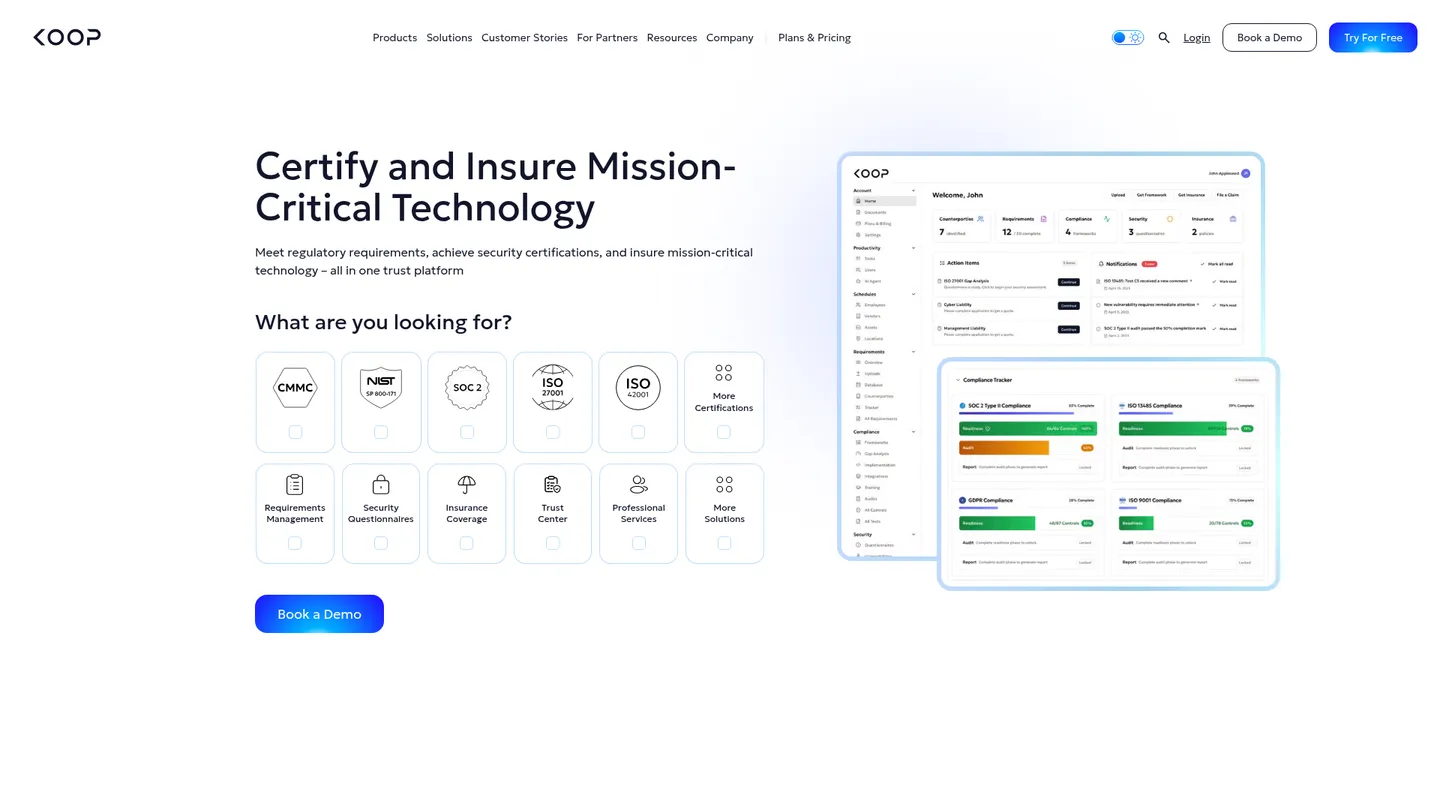
Koop is an AI-native customer-assurance platform that brings compliance certifications, contractual requirements, security questionnaires, trust-center publishing, regulatory intelligence, and liability insurance into one workflow. Teams can collect and validate evidence, generate requirements, monitor controls, manage policies, and share trust assets with buyers. Its Housekeeper AI agents and expert-in-the-loop services support implementation, while the platform also connects companies with vetted US-based auditors and insurance coverage.
The product covers SOC 2, ISO 27001, CMMC 2.0, HIPAA, GDPR, and more than 50 other frameworks, alongside evidence management, continuous control monitoring, vendor and counterparty workflows, questionnaire automation, and regulatory alerts. Its unusual differentiator is bundling general liability, technology errors and omissions, cyber liability, management liability, and certificates of insurance with GRC work. Insurance is available only to US companies and remains subject to underwriting; bespoke integrations and advanced workflows vary by plan.
Koop targets startups, mid-market companies, and enterprises whose sales depend on satisfying procurement, security, or government requirements, particularly in regulated and emerging industries. A free Basic plan includes a trust center, regulatory intelligence, free SOC 2 controls, a contract-compliance trial, and $100,000 of universal cyber protection. Paid Starter plans begin at $10,000 per year, Growth begins at $25,000 per year, and higher-end requirements are custom-priced.
Key features
Framework automation
Automates controls, policies, evidence, testing, and audit preparation across SOC 2, ISO 27001, CMMC, HIPAA, GDPR, and 50+ frameworks.
Requirements management
Extracts and tracks customer, partner, contract, and government requirements with evidence validation and counterparty status tracking.
AI workflow automation
Housekeeper AI agents update evidence, support policy decisioning, and automate custom compliance workflows with expert oversight.
Security questionnaires
Automates VSA, SIG, CAIQ, and custom security or procurement questionnaires using the company knowledge base.
Trust center
Publishes certifications, insurance certificates, badges, and contract-assessment materials through a centralized buyer-facing trust center.
Third-party risk
Supports vendor onboarding, continuous third-party risk automation, automated risk scoring, and advisory workflows.
Business insurance
Arranges general liability, technology errors and omissions, cyber liability, management liability, and certificates of insurance alongside compliance work.
Koop pricing
Koop publishes a free Basic plan, Starter from $10,000 per year, Growth from $25,000 per year, and custom higher-end plans. Starter includes one core certification; Growth expands framework coverage, requirements management, counterparty management, and questionnaire automation. Insurance coverage and fees should be reviewed separately from the compliance subscription.
| Plan | Price | What's included |
|---|---|---|
| Basic | Free | Custom compliance recommendation, contract-compliance trial, regulatory intelligence, free SOC 2 controls, trust center, $100K universal cyber protection, risk consultation |
| Starter | $10,000+ per year | One core certification, white-glove onboarding, base Housekeeper AI, expert-in-the-loop hours, evidence and risk management, integrations, monitoring, expanded trust center, insurance management |
| Growth | $25,000+ per year | Everything in Starter, three or more frameworks, extended Housekeeper AI, custom controls and scenarios, expanded contract and counterparty management, limited questionnaire automation |
| Enterprise | Custom | Custom AI workflows, custom compliance recommendations, advanced requirements, questionnaire and counterparty support, tailored services |
Free trial: Basic is free and includes a free contract-compliance trial; paid-plan trial terms are not published.
Pros & cons
Pros
- Combines GRC automation, customer requirements, trust sharing, and insurance in one platform.
- Publishes a genuinely free entry plan with SOC 2 controls and a trust center.
- Supports a broad framework catalog and 200+ integrations.
- Offers white-glove onboarding, expert services, and access to vetted auditors.
Cons
- Paid pricing starts at a substantial $10,000 annual commitment.
- Insurance is limited to US-based companies and subject to underwriting.
- The platform is broader and more operationally complex than a focused SOC 2 tool.
- The public pricing pages do not clearly expose every plan name, feature limit, or integration.
Who is Koop best for?
- Startups selling into enterprise or government procurement.
- DeepTech, AI, robotics, and other emerging-technology companies with unusual risk profiles.
- Teams that want compliance certification and business insurance from one vendor.
- Companies needing contract requirements, questionnaires, and trust materials managed together.
Frameworks and use cases
Integrations
Notable customers
Frequently asked questions
How much does Koop cost?
+
Koop has a free Basic plan. The current plans page lists Starter at $10,000 or more per year and Growth at $25,000 or more per year; enterprise configurations are custom-priced.
How does Koop work and how long does implementation take?
+
Koop connects evidence sources, maps controls to selected frameworks, manages requirements, and uses Housekeeper AI agents plus expert support to maintain the program. The company does not publish a standard implementation timeline; onboarding scope depends on frameworks, integrations, and services.
How does Koop compare with Vanta?
+
Vanta is a focused compliance automation competitor, while Koop adds contract requirements, security questionnaires, regulatory intelligence, trust-center workflows, and business insurance. Koop is a stronger fit when customer assurance and coverage must be coordinated rather than handled as separate purchases.
What integrations does Koop support?
+
Koop says it supports more than 200 integrations, including AWS, Google Cloud, and Microsoft Azure. Buyers should confirm the exact connector and monitoring depth for their stack and plan.
Who is Koop for?
+
Koop is built for startups through enterprises selling to demanding commercial or government buyers. Its positioning is especially relevant to regulated and emerging-technology companies that need certification, contractual assurance, questionnaires, and insurance.
Is Koop secure and accurate enough for compliance work?
+
Koop provides evidence validation, continuous control monitoring, automated policy and workflow support, and expert-in-the-loop services, but AI output still requires review by the customer and auditor. Insurance availability and final terms are subject to underwriting, and buyers should review Koop's security documentation during procurement.
Sources
Facts and pricing verified on October 19, 2026. Vendors change pricing often, so confirm with Koop before buying. How we research