 Pilot
 Fondo
 Kruze Consulting
 Boast
 Basis
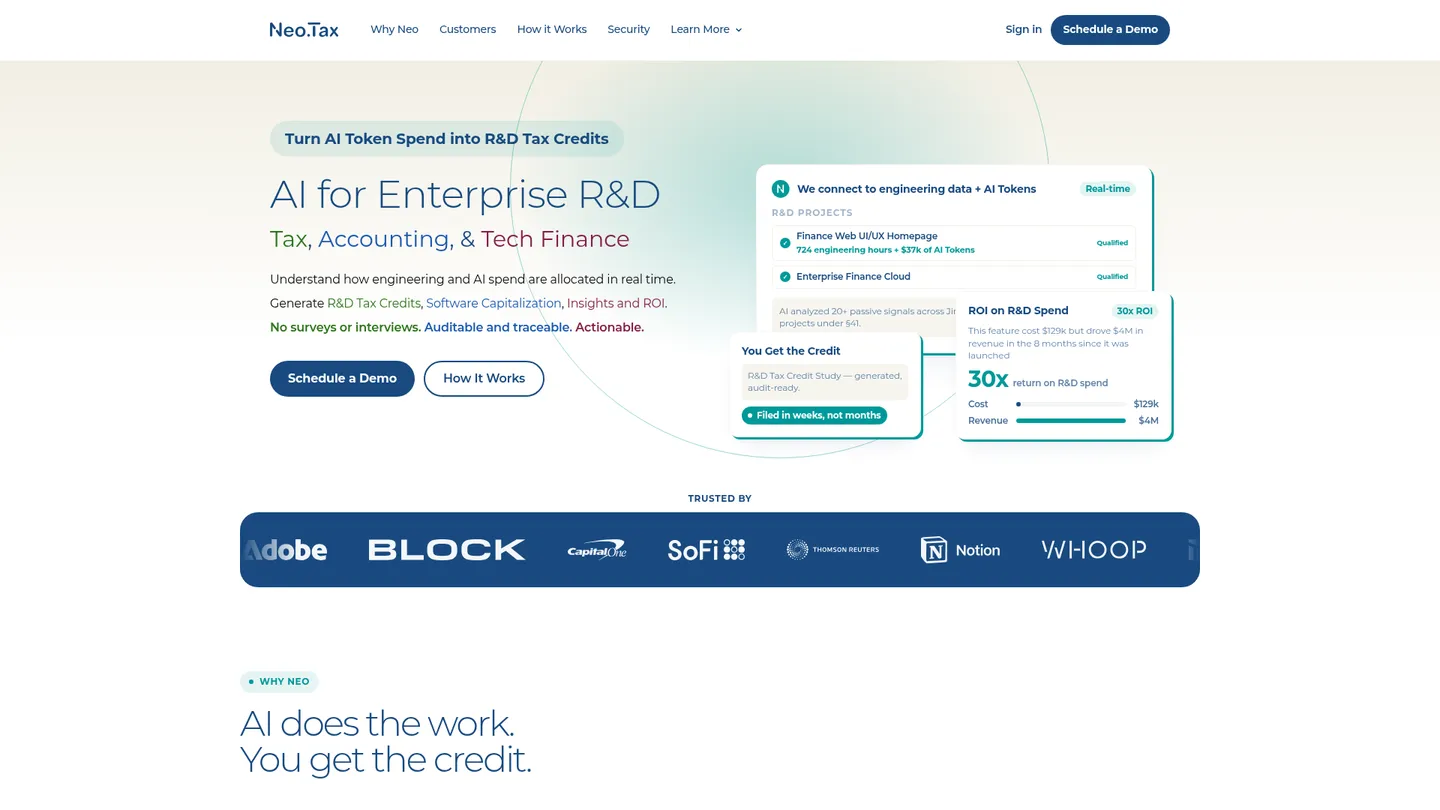
What is Neo.Tax?
Founded in 2019 and based in Mountain View, California, Neo.Tax automates R&D tax credit and software-capitalization work for startups and growing companies. It announced $13 million across its seed and Series A rounds.
Neo.Tax connects to engineering, payroll and finance data, then runs six AI agents across tickets, epics, pull requests, repositories, organizational records and ledgers. The system clusters work into projects, applies IRS qualification logic, calculates qualified research expenditures, creates project narratives and produces audit-ready studies. Its stated design avoids year-end surveys and routine engineer interviews by using contemporaneous source data, while reviewers can edit records and tax specialists can review exceptions before delivery.
The product covers federal R&D tax credit work under Section 41, R&D capitalization under Section 174, and software capitalization under ASC 350-40. It provides project- and employee-level QRE detail, ticket-level evidence, workpapers and audit-log lineage, and supports provision-as-actual workflows. Neo.Tax does not include IRS representation under a power of attorney, fee indemnification, penalty coverage or tax opinions. Section 174A coverage was not specifically documented in the reviewed product materials.
Neo.Tax is aimed at finance, tax and accounting teams with meaningful software-development activity, particularly organizations that want evidence tied to engineering systems rather than lengthy surveys. Capterra describes the earlier self-service offering as suited to startups and small businesses meeting specific eligibility criteria, while the current enterprise product emphasizes security and dedicated deployments. Current pricing is not published: the company describes a flat annual subscription based on R&D-employee population plus a one-time implementation fee, with ASC 350-40 and dedicated hosting as possible additions.
Key features
R&D project qualification
Analyzes engineering signals from systems such as Jira and GitHub to identify and classify qualified projects under Section 41.
QRE calculation
Connects payroll and ledger data to calculate qualified research expenditures at project and employee level.
Audit-ready studies
Generates project narratives, workpapers, evidence trails and R&D tax credit deliverables designed for audit support.
Section 174 capitalization
Produces R&D capitalization outputs for Section 174 alongside the R&D credit workflow.
ASC 350-40 capitalization
Supports software capitalization using the same engineering dataset as the R&D credit study.
Continuous tax visibility
Runs agents continuously over source data to support provision-as-actual reporting and reduce return-to-provision changes.
Enterprise security
Offers SOC 2 Type II, ISO 27001:2022, SSO, encryption, dedicated environments and bring-your-own-cloud options.
Neo.Tax pricing
Neo.Tax states that pricing is a flat annual subscription tiered by R&D-employee population, plus a one-time implementation fee. Pricing is not a percentage of the credit. ASC 350-40 and dedicated single-tenant hosting may be priced as separate annual additions. Capterra lists pricing as not provided by the vendor; its earlier product description says users could prepare a federal R&D credit themselves or with team guidance.
| Plan | Price | What's included |
|---|---|---|
| Core subscription | Custom annual quote | R&D tax credit workflow, connected data ingestion, AI qualification and QRE calculation, audit-ready study and review support. |
| Implementation | Custom one-time fee | Data access setup, connection and implementation support. |
| ASC 350-40 | Custom annual add-on | Software capitalization deliverable using the engineering dataset. |
| Dedicated hosting | Custom annual add-on | Dedicated single-tenant deployment or customer-hosted option. |
Free trial: No current free trial or public trial terms were verified.
Pros & cons
Pros
- Uses Jira, GitHub, payroll and ledger signals instead of relying primarily on year-end surveys.
- Combines R&D credit, Section 174 and ASC 350-40 outputs in one engineering-data workflow.
- Provides ticket-level evidence, workpapers and audit-log lineage for review and audit support.
- Offers strong enterprise controls including SOC 2 Type II, ISO 27001:2022 and dedicated environments.
Cons
- Pricing is quote-based and includes a one-time implementation fee rather than a published self-serve rate.
- The current enterprise workflow may be more than very small companies need for a simple credit claim.
- Routine work still depends on the quality and completeness of connected engineering and payroll data.
- The reviewed materials do not specifically document Section 174A coverage or IRS representation under a power of attorney.
Who is Neo.Tax best for?
- Software companies that want R&D evidence linked to engineering tickets and code activity.
- Tax and finance teams combining Section 41 credit work with Section 174 or ASC 350-40 capitalization.
- Organizations that need audit trails, project-level QRE detail and contemporaneous documentation.
- Enterprises requiring SOC 2, SSO, dedicated tenancy or customer-hosted deployment options.
Coverage
Integrations
Notable customers
Frequently asked questions
How much does Neo.Tax cost?
+
Neo.Tax does not publish a starting price. Its current pricing description is a flat annual subscription tiered by R&D-employee population, plus a one-time implementation fee; ASC 350-40 and dedicated hosting can be additional annual charges.
How long does implementation take and how does the workflow work?
+
Neo.Tax says implementation typically takes four to six weeks from data access to a reviewed draft. The stated sequence is connection in week one, review and refinement in weeks two and three, QRE calculation around week four, and delivery during weeks four through six.
How does Neo.Tax compare with a traditional R&D tax adviser?
+
Neo.Tax uses connected engineering data and AI agents to produce a study in days or weeks without routine surveys or interviews. Traditional approaches may rely more heavily on interviews and manual collection, while Neo.Tax also offers ticket-level lineage and continuous visibility; it does not include IRS representation under a power of attorney.
Which integrations does Neo.Tax support?
+
The documented workflow ingests Jira, GitHub, payroll and ledger data, and a Merge case study confirms live ticketing integrations including Asana, Jira and GitHub. Enterprise identity integrations include Okta, OneLogin, Microsoft Entra and Ping Identity through SAML or OIDC.
Who is Neo.Tax for?
+
The product is designed for finance, tax and accounting teams at software companies and other organizations with engineering activity. Capterra describes the earlier offering as aimed at startups and small businesses, including companies with under $5 million in revenue or no revenue, fewer than five profitable years and US-based R&D workers or contractors.
Is Neo.Tax secure and accurate enough for tax work?
+
Neo.Tax states that it has SOC 2 Type II and ISO 27001:2022 certifications, AES-256 encryption, role-based access controls, SSO and annual third-party penetration testing. Its agents are trained on IRS code, regulations and case law, and claims are reviewed by tax specialists, but customers remain responsible for reviewing outputs with their tax advisers.
Sources
Facts and pricing verified on October 19, 2026. Vendors change pricing often, so confirm with Neo.Tax before buying. How we research