 Workiva
 Diligent
 LogicGate Risk Cloud
 Archer
 TeamMate+
What is Optro?
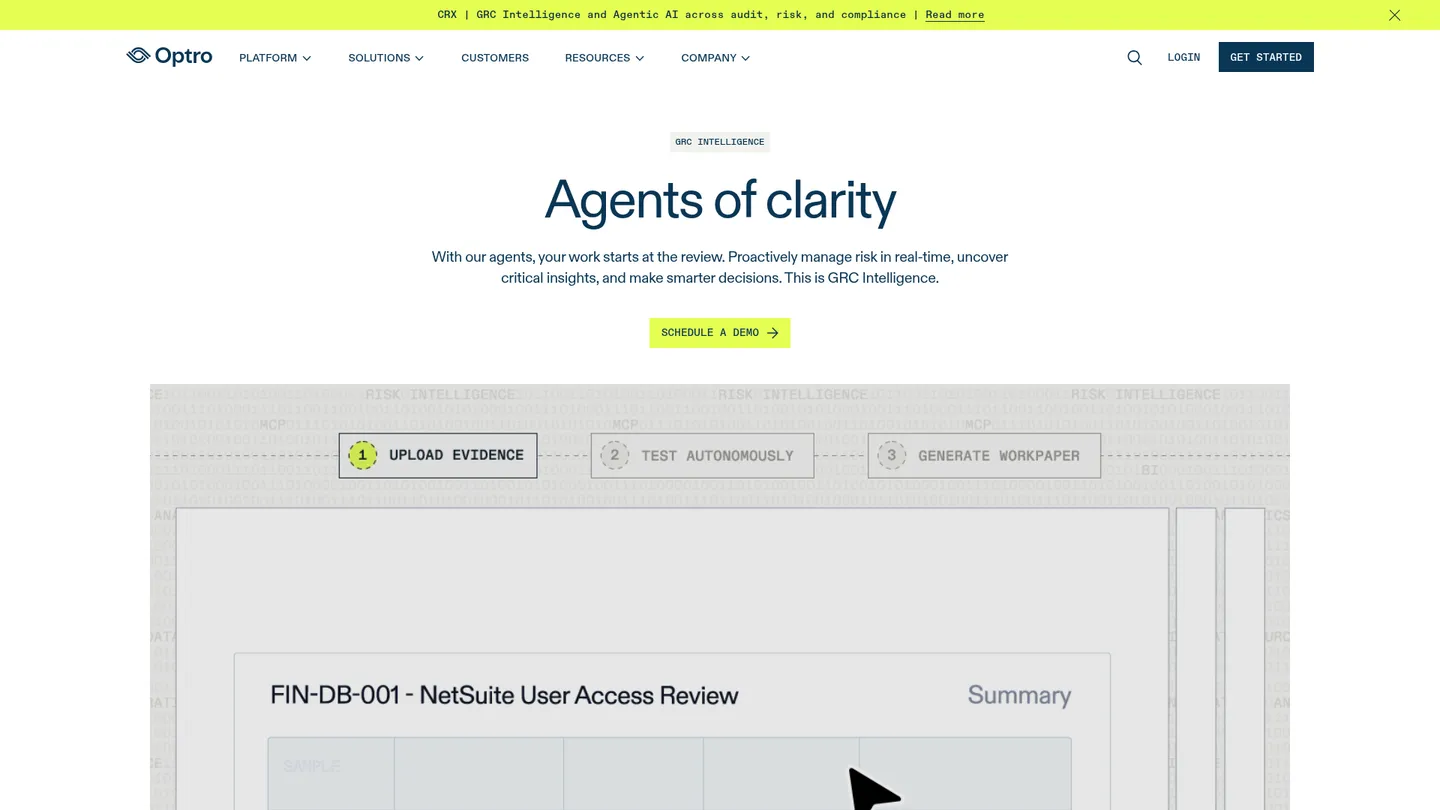
Optro, known as AuditBoard until its March 2026 rebrand, is an enterprise platform for SOX compliance, internal audit, enterprise risk, IT and cyber risk, third-party risk and ESG reporting. Founded in 2014 and owned by Hg since a 2024 deal valued at over $3 billion, it is used by more than half of the Fortune 500.
AuditBoard announced on March 9, 2026 that it is now Optro, with its website moving to optro.ai. The rebrand reflects its expansion from SOX and internal audit software into enterprise-wide governance, risk and compliance. Existing customers keep the same platform, team and contracts.
The platform connects controls, risks, issues, evidence and reporting across functions. Its modules are SOXHub (SOX management), OpsAudit (internal audit), RiskOversight (ERM), ITRM (IT and cyber risk), third-party risk and ESG. Because these modules share workflows and a common control library, one control test or evidence request can serve audit, risk and compliance teams at once. Newer AI features draft documents, process evidence and assist testing, with human review built in.
Optro is aimed at enterprise and upper mid-market audit, risk and compliance teams rather than small companies looking for self-serve compliance software. Pricing is quote-based, and Vendr reports a median contract of about $46,000 per year. Reviewers praise its usability for auditors and control owners and its responsive support. They criticize configuration limits in complex SOX scoping, the learning curve for advanced workflows and occasional disruption from updates.
Key features
SOX management (SOXHub)
Risk assessments, control documentation, testing, control-owner workflows and reporting, with AI-assisted planning and fieldwork.
Internal audit (OpsAudit)
Risk-based audit planning, workpapers, evidence requests, testing, issues and reporting with configurable workflows.
Enterprise risk (RiskOversight)
Enterprise and operational risk registers, assessments, mitigation plans, risk appetite and scenario analysis.
IT and cyber risk (ITRM)
Assess and prioritize IT assets and cyber risks, quantify financial impact, and track vulnerabilities and remediation.
Third-party risk
Vendor tiering, due-diligence questionnaires, report collection, and findings tracking with AI-assisted reviews.
ESG reporting
Collect and verify ESG metrics and evidence, map them to CSRD and SASB-aligned disclosures, and link them to ERM.
AI and agents
AI drafting, document analysis, evidence processing and test assistance with configurable human oversight.
Optro pricing
Optro doesn't publish prices. Its pricing page emphasizes unlimited stakeholder licenses, flexible module-based plans and included implementation services. Vendr reports a median contract of $45,947/year across 86 purchases, with observed contracts ranging from about $21,000 to $111,000 per year. Confirm practitioner seats, modules, AI entitlements, integrations and renewal terms before signing.
| Plan | Price | What's included |
|---|---|---|
| Single module | From ~$21K/yrLow end of Vendr range | One solution such as SOXHub or OpsAudit, unlimited stakeholder licenses, implementation support |
| Typical deployment | ~$46K/yrVendr median, 86 purchases | Multiple modules across audit, SOX and risk, with shared controls and reporting |
| Enterprise platform | $100K+/yrUpper Vendr range | Full connected-risk suite including ITRM, third-party risk, ESG and AI features |
Free trial: No self-serve trial. Demo by request
Pros & cons
Pros
- Intuitive for auditors and occasional control owners alike
- Centralized workpapers, evidence and issues replace spreadsheet sprawl
- Strong SOX workflows and live status dashboards
- Responsive customer support and frequent product releases
Cons
- Learning curve for advanced workflows and configuration
- SOX scoping hierarchy can feel rigid across multiple ERPs
- Limits on reporting and field customization
- Opaque, enterprise-level pricing makes it poorly suited to small teams
Who is Optro best for?
- Enterprise internal audit and SOX teams coordinating many control owners and external auditors
- Upper mid-market companies replacing spreadsheets with structured audit and risk workflows
- Organizations unifying audit, ERM, IT risk, third-party risk and ESG on one data model
- Teams with budget for a scoped implementation and an annual enterprise contract
Use cases & frameworks
Integrations
Notable customers
Frequently asked questions
Is AuditBoard now called Optro?
+
Yes. AuditBoard announced its rebrand to Optro on March 9, 2026 and moved to optro.ai. Existing customers keep the same platform, team and contracts.
How much does AuditBoard (Optro) cost?
+
Pricing is quote-based. Vendr reports a median contract of $45,947/year across 86 purchases, with observed contracts from about $21,000 to $111,000 per year depending on modules and scope.
Is there a free trial?
+
There is no self-serve free trial. Optro offers sales-led demos, and you can ask about a scoped evaluation during the sales process.
Do all stakeholders need paid seats?
+
Optro advertises unlimited stakeholder licenses, so control owners and contributors don't need paid seats. Check which practitioner, admin and AI permissions your contract includes.
What does AuditBoard (Optro) cover?
+
SOX compliance, internal audit, enterprise and operational risk, IT and cyber risk, third-party risk and ESG reporting, with 30+ preloaded frameworks and 200+ integrations.
AuditBoard vs Workiva: which is better for SOX?
+
Both are leading SOX platforms. AuditBoard (Optro) is generally preferred for audit workflow usability and connected risk modules. Workiva is stronger when SOX work needs to connect to SEC and financial reporting documents.
Sources
Facts and pricing verified on October 19, 2026. Vendors change pricing often, so confirm with Optro before buying. How we research