 ComplyAdvantage
 Socure
 Trulioo
 Persona
 Sardine
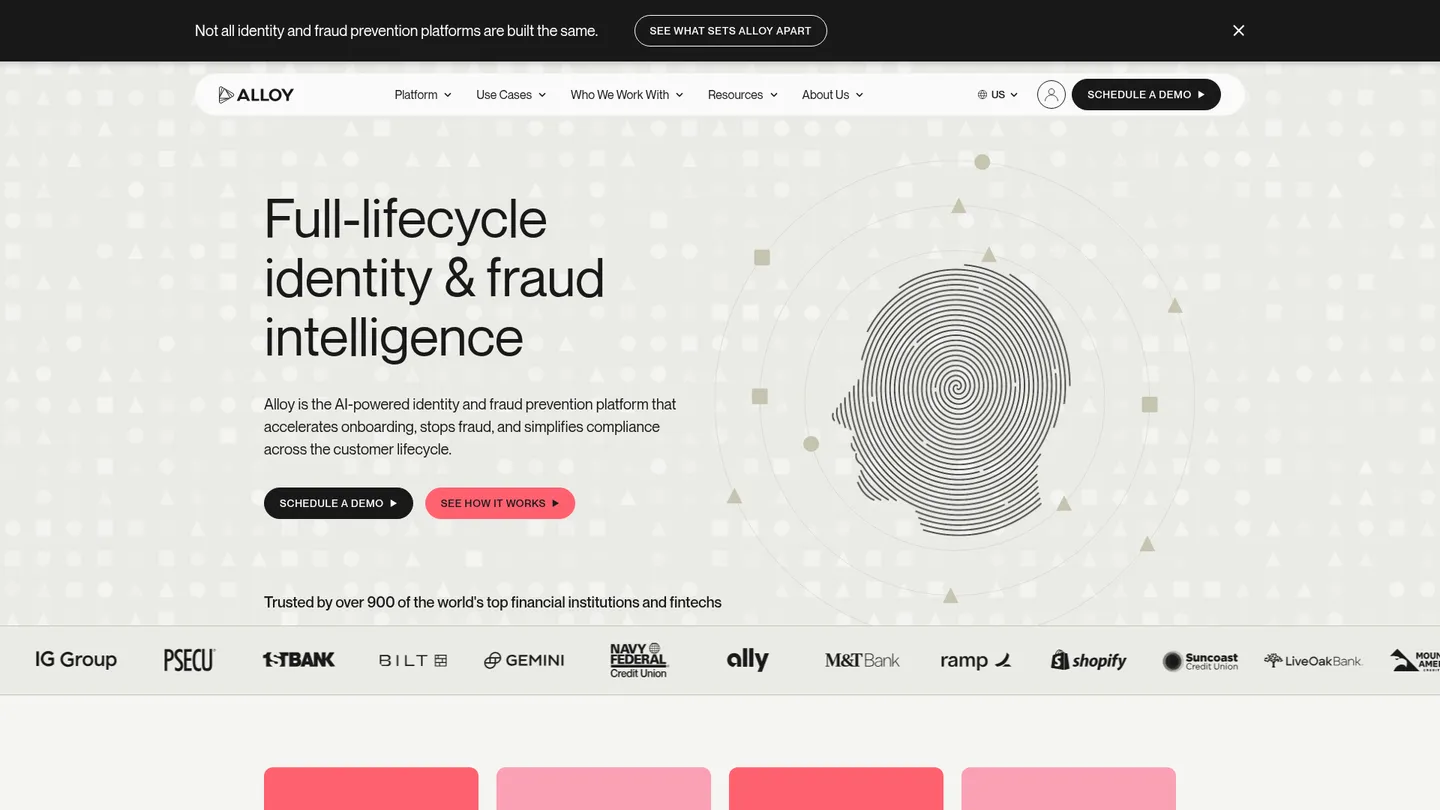
What is Alloy?
Founded in 2015 and headquartered in New York, Alloy is a financial-crime and identity-risk platform for banks, credit unions and fintechs. More than 900 financial institutions and fintechs use it for onboarding, monitoring, fraud prevention and compliance.
Alloy is a centralized risk-decisioning platform that combines identity, fraud and compliance signals in configurable workflows. Financial institutions use it to automate KYC, KYB and AML checks during onboarding, then carry the resulting identity and risk context into servicing, authentication and money movement. Its orchestration layer connects data providers and applies risk-based policies, allowing teams to approve lower-risk applicants quickly while routing exceptions to manual review. Alloy also supports continuous monitoring rather than treating onboarding as a one-time check.
The product spans consumer and business onboarding, identity verification, sanctions and watchlist screening, fraud prevention, transaction and non-monetary event monitoring, perpetual KYC and KYB, AML case management, regulatory filings and credit decisioning. Alloy says its network includes more than 300 solution partners, while its broader solutions page cites 250-plus identity data integrations, reflecting changing product scope and packaging. It is designed for regulated financial services rather than general-purpose compliance, and buyers still need to configure policies, investigate escalations and govern automated decisions.
Alloy is aimed at banks, credit unions, fintechs, embedded-finance programs and other financial institutions that need one risk stack across acquisition and account life. The company sells an enterprise platform with quote-based pricing; no public Alloy price list or free plan is stated on its product pages. A Software Advice listing gives a $25,000-per-year benchmark, but labels it as a starting price and does not establish Alloy's current standard rate. Prospective buyers should expect pricing to vary with volume, markets, data providers and modules.
Key features
KYC and KYB
Automates consumer and business identity checks, risk scoring and rechecks across onboarding and ongoing relationships.
AML monitoring
Applies configurable and out-of-the-box rules to detect typologies such as structuring, funneling and money-mule activity.
Fraud prevention
Combines identity, device, behavioral and transaction signals with configurable friction and step-up actions.
Perpetual KYC
Continuously refreshes customer information and triggers new checks when risk, behavior or account data changes.
Case management
Routes alerts into customizable queues for investigation, collaboration, escalation and regulatory filing workflows.
Decision orchestration
Lets teams combine multiple data providers and risk policies in a single decisioning workflow without changing every vendor integration.
Credit decisioning
Supports credit underwriting with consumer-credit and other risk data alongside identity and fraud signals.
Alloy pricing
Alloy does not publish standard plan prices; sales discussions determine the package and data usage. Software Advice lists Alloy from $25,000 per year, but this is a third-party benchmark rather than an official price sheet. Actual cost can vary with applicant and account volume, jurisdictions, selected partners, monitoring needs and modules.
| Plan | Price | What's included |
|---|---|---|
| Platform | CustomCore risk decisioning and orchestration | Configurable workflows, policy logic, identity and fraud data orchestration, decisioning and audit trails |
| Onboarding | CustomConsumer and business acquisition | KYC, KYB, AML and fraud checks, risk-based routing, step-up verification and manual review |
| Ongoing monitoring | CustomLifecycle risk management | Perpetual KYC and KYB, transaction and non-monetary event monitoring, alerts and account actions |
| Compliance | CustomFinancial-crime operations | AML monitoring, sanctions and watchlist workflows, case management, investigations and regulatory filings |
Free trial: No public free trial is stated on Alloy's official product pages.
Pros & cons
Pros
- Connects identity, fraud and compliance workflows instead of forcing teams to operate separate decisioning systems.
- Supports both consumer and business onboarding with KYC, KYB, AML and fraud signals.
- Extends risk controls beyond account opening through perpetual KYC, KYB and event monitoring.
- Its partner network lets teams combine data providers and change sources without rebuilding every workflow.
Cons
- Pricing is quote-based, so buyers cannot estimate a standard subscription from an official rate card.
- The platform is built for regulated financial services and may be excessive for organizations needing only basic identity checks.
- Automated decisions still require policy configuration, governance and analyst handling for unresolved or high-risk cases.
- Coverage and operating cost depend on selected third-party data providers, markets and transaction or applicant volumes.
Who is Alloy best for?
- Banks needing one decisioning layer across onboarding and account servicing.
- Fintechs that need configurable KYC, KYB and fraud workflows without maintaining many point integrations.
- Credit unions modernizing identity verification, fraud controls and ongoing monitoring.
- Embedded-finance programs managing compliance across multiple products and partners.
Coverage
Integrations
Notable customers
Frequently asked questions
How much does Alloy cost?
+
Alloy uses quote-based enterprise pricing and does not publish standard plans on its official product pages. Software Advice lists a starting benchmark of $25,000 per year, but the final quote depends on volumes, jurisdictions, data providers, monitoring and selected modules.
How does Alloy work and how long does implementation take?
+
Teams connect Alloy to onboarding or account systems, select data partners, and configure risk policies and review workflows. Alloy then orchestrates checks and routes decisions or exceptions; implementation time is not publicly specified and will vary with integrations, policy complexity and governance requirements.
How does Alloy compare with ComplyAdvantage?
+
Alloy is a broader lifecycle decisioning platform covering onboarding, fraud, identity, monitoring and compliance workflows. ComplyAdvantage is best known for sanctions, watchlist and financial-crime data and monitoring, so Alloy is the closer fit when a buyer wants orchestration across multiple identity and fraud providers rather than a primarily screening-focused service.
Which integrations does Alloy support?
+
Alloy says it connects with more than 300 solution partners. Named partners include Experian, Equifax, LexisNexis Risk Solutions, Socure, Trulioo, Middesk, nCino and Narmi, spanning identity, business verification, credit, fraud, core banking and onboarding.
Who is Alloy for?
+
Alloy is built for banks, credit unions, fintechs and embedded-finance programs. It is most useful where compliance, fraud and identity teams need shared risk decisions from application through ongoing servicing and money movement.
Is Alloy secure and accurate enough for regulated decisions?
+
Alloy provides configurable rules, auditable workflows, case management and multiple data sources, helping teams document decisions and investigate exceptions. It does not eliminate the need for a financial institution's own model validation, vendor oversight, human review and compliance governance.
Sources
Facts and pricing verified on October 19, 2026. Vendors change pricing often, so confirm with Alloy before buying. How we research