
 Optro
 Workiva
 FloQast
 BlackLine
 Numeric
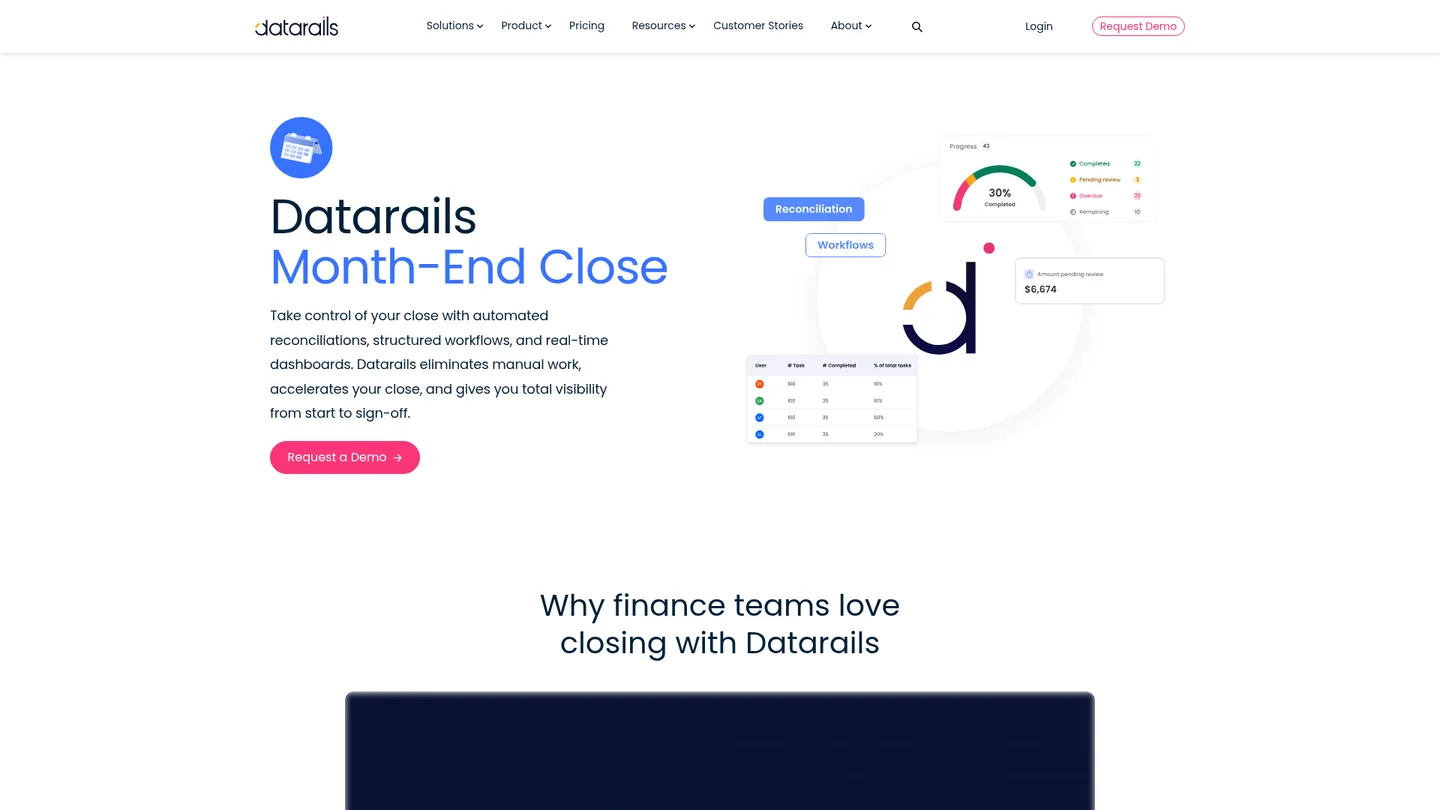
What is Datarails Close?
Datarails, founded in 2015 and headquartered in New York, provides FinanceOS for finance teams. Datarails Close is its month-end close module, launched in 2025, with more than 2,000 companies using the broader platform.
Datarails Close is a month-end close module inside Datarails FinanceOS, rather than a standalone accounting system. It brings close dates, account reconciliations, preparer and reviewer assignments, supporting documents and workflow tasks into one workspace. Finance teams can configure recurring workflows, set thresholds and due dates, and monitor task and reconciliation status from summary dashboards. The module is designed to replace email-driven checklists and spreadsheet matching with a governed process from preparation through sign-off.
The core workflow combines automated reconciliation preparation, transaction matching, exception flags, approvals, centralized evidence and an audit log. Teams can upload or sync trial balances, track differences by entity and currency, and block sign-off when balances exceed configured thresholds. It also supports dependencies, recurring workflows and audit-package exports. The product’s breadth depends on the wider Datarails data layer and connectors; it is not a general ledger, statutory filing system or full close-and-consolidation replacement.
Datarails sells Close as a module layered onto its FinanceOS plans, with pricing supplied through a custom quote rather than a published Close price. The company lists Professional, Premium and Expert plans, differentiated by users, integrations and support, while Month-End Close is available as a purpose-built add-on. It is aimed at controllers, accounting managers and finance teams managing recurring multi-entity closes. Datarails says typical Close implementations and training take one to three weeks, depending on data complexity.
Key features
Automated reconciliations
Matches and validates account data, flags exceptions and keeps supporting evidence and reconciliation status together.
Close workflows
Creates recurring monthly, quarterly or yearly workflows with dependencies, checklists, owners and due dates.
Preparer approvals
Assigns preparers and reviewers, applies thresholds and records sign-off after differences are resolved.
Close dashboards
Shows task progress, reconciliation status, overdue work, blockers and workload across the close.
Supporting documents
Centralizes files, adjustments and other evidence alongside the relevant workflow or reconciliation.
Audit trail
Maintains change, approval and sign-off records and supports audit-package exports.
Datarails Close pricing
Datarails does not publish a list price for Close; buyers request a quote based on users, integrations, modules and scope. Datarails’ pricing page places Month-End Close among add-on FinanceOS products. Vendr reports anonymized broader Datarails contracts typically ranging from $25,000 to $150,000 or more annually, but that benchmark is for Datarails rather than Close alone.
| Plan | Price | What's included |
|---|---|---|
| Professional | Custom quote | FinanceOS, unlimited dashboards, reporting and planning, 2 users, 1 integration and standard support. |
| Premium | Custom quote | Everything in Professional, 5 users, 2 integrations and premium support. |
| Expert | Custom quote | Everything in Premium, 15 users, 3 integrations and premium support; one additional product such as Month-End Close. |
| Month-End Close add-on | Custom quote | Close workflows, reconciliations, supporting documentation, approvals, dashboards and auditability; exact scope is quoted. |
Free trial: No public free trial or free plan is listed.
Pros & cons
Pros
- Automates reconciliation preparation and exception handling instead of relying solely on manual spreadsheet matching.
- Combines tasks, reconciliations, approvals and evidence in one close workspace.
- Configurable thresholds can prevent sign-off when differences remain unresolved.
- Datarails says typical implementation and training take one to three weeks.
Cons
- Pricing is quote-only, with no public Close-specific starting price.
- Close is a FinanceOS module rather than a standalone general ledger or accounting platform.
- The product’s connector breadth and data model are tied to the broader Datarails platform.
- The broader Datarails G2 feedback includes reports of setup complexity and a learning curve.
Who is Datarails Close best for?
- Controllers coordinating recurring close tasks across multiple entities.
- Finance teams that want reconciliation workflows without abandoning Excel-connected data processes.
- Organizations needing centralized supporting evidence and reviewer sign-offs for audits.
- Datarails customers adding close management to an existing FinanceOS deployment.
Audit areas
Integrations
Frequently asked questions
How much does Datarails Close cost?
+
Datarails does not publish a Close price; it sells the module through a custom quote. The wider Datarails pricing page lists Professional, Premium and Expert plans, and Vendr places broader Datarails annual contracts at roughly $25,000–$150,000 or more, depending on deployment.
How does Datarails Close work?
+
Teams set close dates, assign preparers and reviewers, configure thresholds, and create recurring workflows with tasks and dependencies. Reconciliations, supporting documents, approvals and sign-off logs are tracked from the Close summary page.
How does Datarails Close compare with FloQast?
+
Both target accounting teams managing close checklists, reconciliations and evidence. Datarails Close’s differentiator is its position inside an Excel-connected FinanceOS with 600-plus system connections, while the right choice depends on the existing finance data stack and required close depth.
What does Datarails Close integrate with?
+
Datarails says the module connects through the platform to more than 600 systems. Named integrations include NetSuite, QuickBooks, Sage Intacct, Dynamics 365, SAP Business One, Salesforce, Xero and Excel.
Who is Datarails Close for?
+
It is designed for controllers, accounting managers and finance teams coordinating recurring month-end, quarterly or annual close work. It is particularly suited to organizations already using Datarails or needing governed reconciliations across entities and reviewers.
Is Datarails Close secure and audit-ready?
+
The module centralizes reconciliation evidence, maintains audit logs and sign-off records, and supports audit-package exports. Datarails states that its platform has SOC 2 Type II and ISO 27001 certifications and supports GDPR, but buyers should validate current controls during procurement.
Sources
Facts and pricing verified on October 19, 2026. Vendors change pricing often, so confirm with Datarails Close before buying. How we research