
 Avalara
 Vertex
 Sovos
 TaxJar
 Stripe Tax
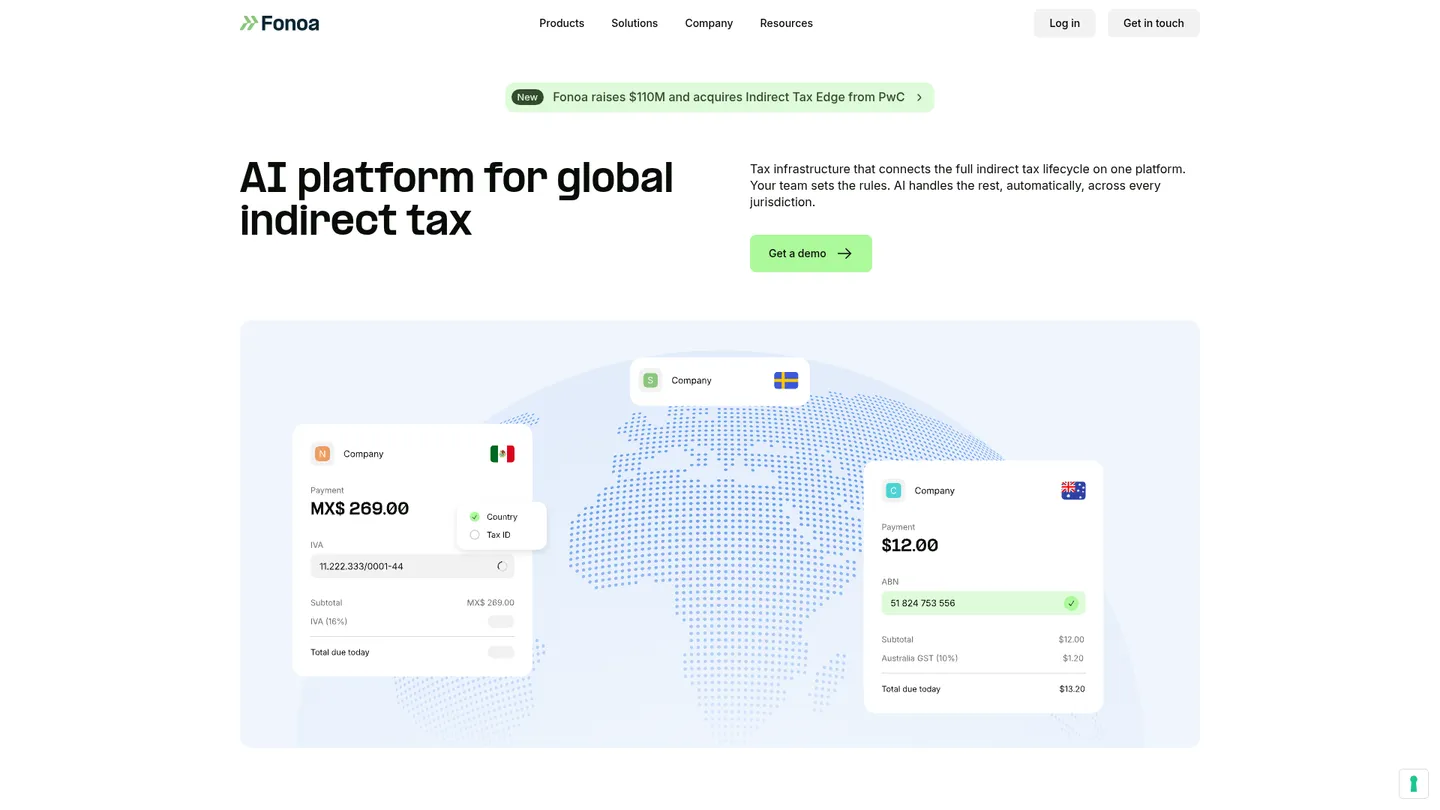
What is Fonoa?
Founded in 2019, Fonoa is an indirect-tax technology company registered in Ireland. Its platform supports tax-ID validation, tax determination, invoicing, e-invoicing, reporting, and returns across international markets.
Fonoa is an API-first indirect-tax platform for digital businesses, marketplaces, and companies operating across borders. Its data model connects tax-ID validation, real-time tax determination, compliant invoicing and e-invoicing, reporting, and returns. APIs support integration with transaction and billing systems, while a web interface gives tax and finance teams visibility into workflows, tax data, and audit history. Modules share transaction data rather than requiring separate disconnected tax workflows.
The platform covers the main indirect-tax lifecycle through separate but connected products: Lookup validates tax IDs, Tax Engine calculates VAT, GST, and sales tax, E-Invoicing supports compliant documents and reporting, and Tax Return automates return preparation and filing. Fonoa also provides regulatory knowledge and audit capabilities. Buyers should confirm country-specific mandates, filing scope, implementation responsibilities, and the exact data and integration requirements for each module.
Fonoa is built for tax, finance, product, and engineering teams at digital-first businesses, platforms, marketplaces, and global enterprises. Public pricing is not listed, and the commercial model is quote-based. G2 reviewers describe usage-based pricing and note that costs can increase with transaction volume, making expected usage and geographic expansion important inputs during procurement. Buyers select modules to match their jurisdictions, transaction flows, and compliance processes.
Key features
Tax ID validation
Validates VAT, GST, and other tax identifiers through live connections to government sources in more than 115 countries.
Real-time tax engine
Determines applicable VAT, GST, sales tax, and other indirect taxes and calculates transaction amounts in real time.
E-invoicing
Provides a unified API for locally compliant e-invoices and connections to tax-authority systems.
Tax returns
Supports indirect-tax return preparation and filing across multiple jurisdictions with source-transaction lineage.
Regulatory intelligence
Provides cited information about global tax legislation and regulatory changes.
Audit data
Maintains tax data, workflow history, and lineage to support audit readiness and reconciliation.
API integration
Connects tax workflows with checkout, onboarding, invoicing, billing, and finance systems.
Fonoa pricing
Fonoa does not publish a price list or self-serve tiers; buyers engage sales for a quote. G2 reviewers describe pricing as usage-based and say costs can rise with transaction volume. Contract scope may vary by product, country coverage, transaction volume, and implementation requirements.
| Plan | Price | What's included |
|---|---|---|
| Custom platform | CustomQuote required | Tax-ID validation, tax determination, invoicing and e-invoicing, reporting, returns, regulatory intelligence, and audit capabilities are scoped to customer requirements |
Free trial: Contact sales to discuss an evaluation and implementation scope.
Pros & cons
Pros
- Covers validation, calculation, invoicing, reporting, and returns in one indirect-tax platform.
- Supports tax determination across more than 190 jurisdictions and tax-ID validation across more than 115 countries.
- Combines APIs for product teams with a web interface for tax and finance users.
- Provides a unified e-invoicing approach across local reporting mandates.
Cons
- Pricing is not public and reviewers say usage-based costs can increase with transaction volume.
- Country coverage does not remove the need to confirm precise local filing and e-invoicing scope.
- Implementation is sales-led rather than self-serve.
- The platform may be more extensive than smaller domestic sellers require.
Who is Fonoa best for?
- Global digital businesses launching products or services across multiple tax jurisdictions.
- Marketplaces and platforms embedding tax determination and invoicing into transaction flows.
- Tax teams consolidating validation, calculation, e-invoicing, reporting, and returns.
- Engineering and finance teams that need APIs plus centralized tax data and audit history.
Coverage
Integrations
Notable customers
Frequently asked questions
How much does Fonoa cost?
+
Fonoa does not publish starting prices or self-serve plan tiers. Contact sales to discuss an evaluation, expected transaction volume, countries, and required modules. G2 reviewers describe usage-based pricing and report that high lookup or transaction volumes can increase cost.
How does Fonoa work and how long does implementation take?
+
Engineering teams connect Fonoa APIs to transaction, billing, or finance workflows, while tax teams use the interface for tax operations, reporting, and review. Fonoa customer material cites implementations measured in weeks, while G2 reports an average implementation time of four months; scope depends on countries, modules, data, and integrations.
How does Fonoa compare with Avalara?
+
Both provide global indirect-tax automation, but Fonoa emphasizes a modular, API-first platform covering validation, determination, invoicing, e-invoicing, and returns. Buyers should compare jurisdiction coverage, filing responsibility, integration effort, support, implementation, and usage pricing.
What integrations does Fonoa support?
+
Public listings identify Chargebee, NetSuite, Oracle Fusion Cloud ERP, SAP S/4HANA Cloud, Salesforce Platform, and Stripe Billing among supported integrations. Availability can vary by module, country, and customer architecture, so the required connectors should be confirmed during scoping.
Who is Fonoa for?
+
Fonoa is designed for digital-first businesses, platforms, marketplaces, and global companies managing indirect tax across multiple markets. It is most relevant where tax, finance, product, and engineering teams need real-time determination together with downstream invoicing and compliance workflows.
Is Fonoa secure and accurate enough for tax operations?
+
Fonoa provides shared tax data, workflow history, and transaction lineage, while its tax engine applies jurisdiction-specific rules. Accuracy depends on source data, configuration, and supported local scope. Buyers should review security documentation, controls, service levels, and testing procedures before production use.
Sources
Facts and pricing verified on October 19, 2026. Vendors change pricing often, so confirm with Fonoa before buying. How we research