
 Avalara
 Sovos
 ONESOURCE
 TaxJar
 Stripe Tax
What is Vertex?
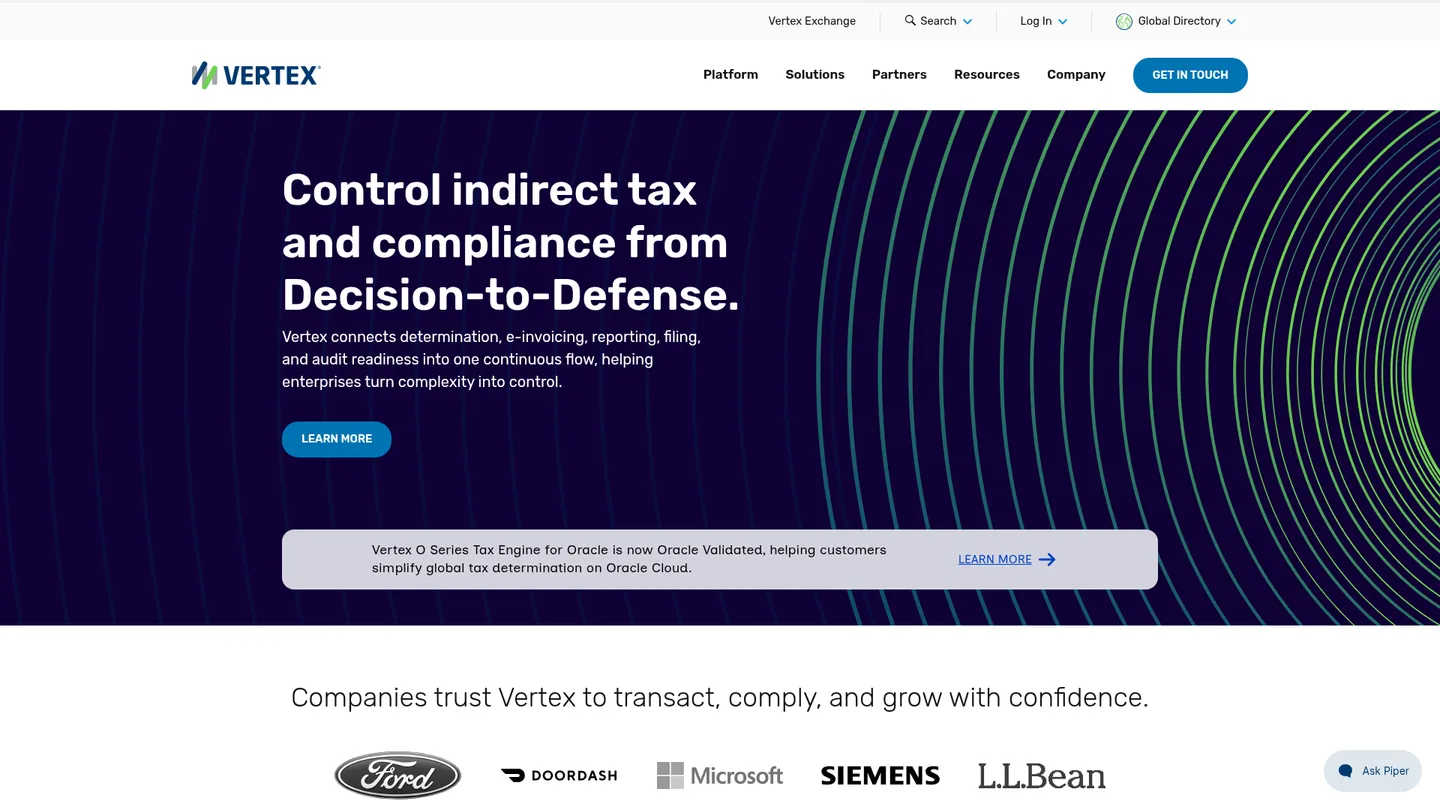
Founded in 1978 and headquartered in King of Prussia, Pennsylvania, Vertex provides enterprise indirect-tax technology for global commerce. The public company reported $748.4 million in 2025 revenue, 4,867 direct customers, and 2,100+ full-time employees.
Vertex is an enterprise tax-compliance platform that calculates and governs transaction taxes across commerce workflows. Its core O Series engine centralizes sales and use tax, consumer use tax, VAT, and GST determination, using maintained tax content and integrations with ERP, billing, procurement, commerce, and other financial systems. Customers can deploy Vertex in the cloud, on premises, or hybrid environments, then extend it with reporting, returns, e-invoicing, and audit-readiness capabilities.
The product breadth is substantial: Vertex combines tax determination, exemption and certificate management, returns, e-invoicing, VAT compliance, tax-data management, analytics, address cleansing, and marketplace services. Its engine supports more than 195 countries and territories and more than 20,000 jurisdictions, while Vertex says it maintains more than one billion tax rates and rules. Coverage and connectors vary by product and geography, and implementation or professional services may be needed for complex enterprise deployments.
Vertex is best suited to mid-market and enterprise organizations with multi-jurisdiction transaction volume, complex supply chains, or global compliance requirements. Public pricing is not posted; Vertex describes revenue-band pricing rather than transaction-volume pricing, and its AWS Marketplace managed-service listing uses private offers and contract terms rather than a standard entry price. The company reported 4,867 direct customers at December 31, 2025, including the majority of the Fortune 500 and nine of the top ten US e-commerce sites.
Key features
Tax determination
Calculates sales, use, consumer use, VAT, and GST taxes across transaction systems and jurisdictions.
Tax content engine
Maintains tax rates, rules, product taxability, and jurisdiction content for global indirect-tax calculations.
Returns compliance
Prepares signature-ready returns, filing workflows, remittance support, and reporting for supported jurisdictions.
E-invoicing and VAT
Creates, validates, submits, clears, tracks, and archives e-invoices while supporting VAT and GST reporting.
Exemption management
Supports exemption certificate workflows and tax-exemption controls for applicable transactions.
Marketplace taxation
Provides APIs and liability determination for marketplace transactions, including VAT, IOSS, OSS, and sales tax.
Audit readiness
Connects transaction data, reporting, reconciliation, and document controls to support audits and compliance defense.
Vertex pricing
Vertex does not publish standard product pricing. Its materials describe revenue-band pricing, while the AWS Marketplace managed Vertex service is available through private offers with 12-, 24-, or 36-month contract terms; displayed $1 dimensions are listing placeholders, not a customer price. Implementation, integration, and infrastructure costs may vary by deployment and scope.
| Plan | Price | What's included |
|---|---|---|
| Vertex O Series | Custom quoteCore tax engine | Sales and use tax, consumer use tax, VAT, GST, tax content, cloud, on-premise, or hybrid deployment |
| Vertex Indirect Tax Returns | Custom quoteReturns and reporting | Return preparation, filing workflows, remittance support, reporting, and compliance operations |
| Vertex e-Invoicing and VAT Compliance | Custom quoteGlobal compliance | E-invoice creation and clearance, VAT/GST reporting, reconciliation, archiving, and mandate support |
| Vertex for Marketplaces | Custom quoteMarketplace APIs | Marketplace tax calculation, liability assignment, indirect-tax coverage, currency conversion, refunds, and discounts |
Free trial: No public free trial is listed.
Pros & cons
Pros
- Supports 195+ countries and territories and more than 20,000 jurisdictions.
- Offers cloud, on-premise, and hybrid deployment options.
- Connects tax determination with returns, e-invoicing, reporting, and audit readiness.
- Revenue-band pricing can make budgeting less dependent on transaction-count volatility.
Cons
- Public pricing is unavailable and requires a scoped quote.
- Complex enterprise implementations may require professional services and integration work.
- Product breadth and jurisdiction coverage vary by module and geography.
- The platform is generally better suited to larger organizations than very small sellers.
Who is Vertex best for?
- Global enterprises managing indirect tax across many jurisdictions.
- Retailers and marketplaces with high-volume, multi-channel transactions.
- Organizations standardizing tax across SAP, Oracle, Salesforce, or Microsoft systems.
- Tax teams needing determination, filing, e-invoicing, and audit data in one vendor relationship.
Coverage
Integrations
Notable customers
Frequently asked questions
How much does Vertex cost?
+
Vertex does not publish a standard starting price. Pricing is quote-based and described as revenue-band pricing; managed AWS Marketplace deployments use private offers and contract terms.
How does Vertex compare with Avalara?
+
G2 lists Vertex at 4.4 out of 5 from 466 reviews and Avalara at 4.0 from 816 reviews. Vertex is positioned more toward enterprise environments, while the right choice depends on deployment, coverage, integrations, and implementation scope.
What integrations does Vertex support?
+
Vertex says it offers more than 150 integrations. Named ecosystems include SAP, Oracle, Microsoft, Salesforce, Workday, NetSuite, e-commerce platforms, procurement systems, and billing applications.
Who is Vertex for?
+
Vertex is designed for organizations with complex indirect-tax operations, including large retailers, manufacturers, wholesalers, technology companies, marketplaces, and multinational businesses. It serves 4,867 direct customers.
How long does implementation take?
+
A universal implementation time is not published because scope depends on systems, jurisdictions, modules, and deployment. Vertex connects through prebuilt integrations, APIs, or custom work.
How does Vertex address security and accuracy?
+
Vertex maintains tax content and says its platform is supported by more than one billion tax rates and rules. Its 2025 annual report describes role-based access controls and cloud services across six geographically separate data centers on two continents.
Sources
Facts and pricing verified on October 19, 2026. Vendors change pricing often, so confirm with Vertex before buying. How we research