
 Stripe Tax
 Lemon Squeezy
 Fonoa
 TaxJar
 Avalara
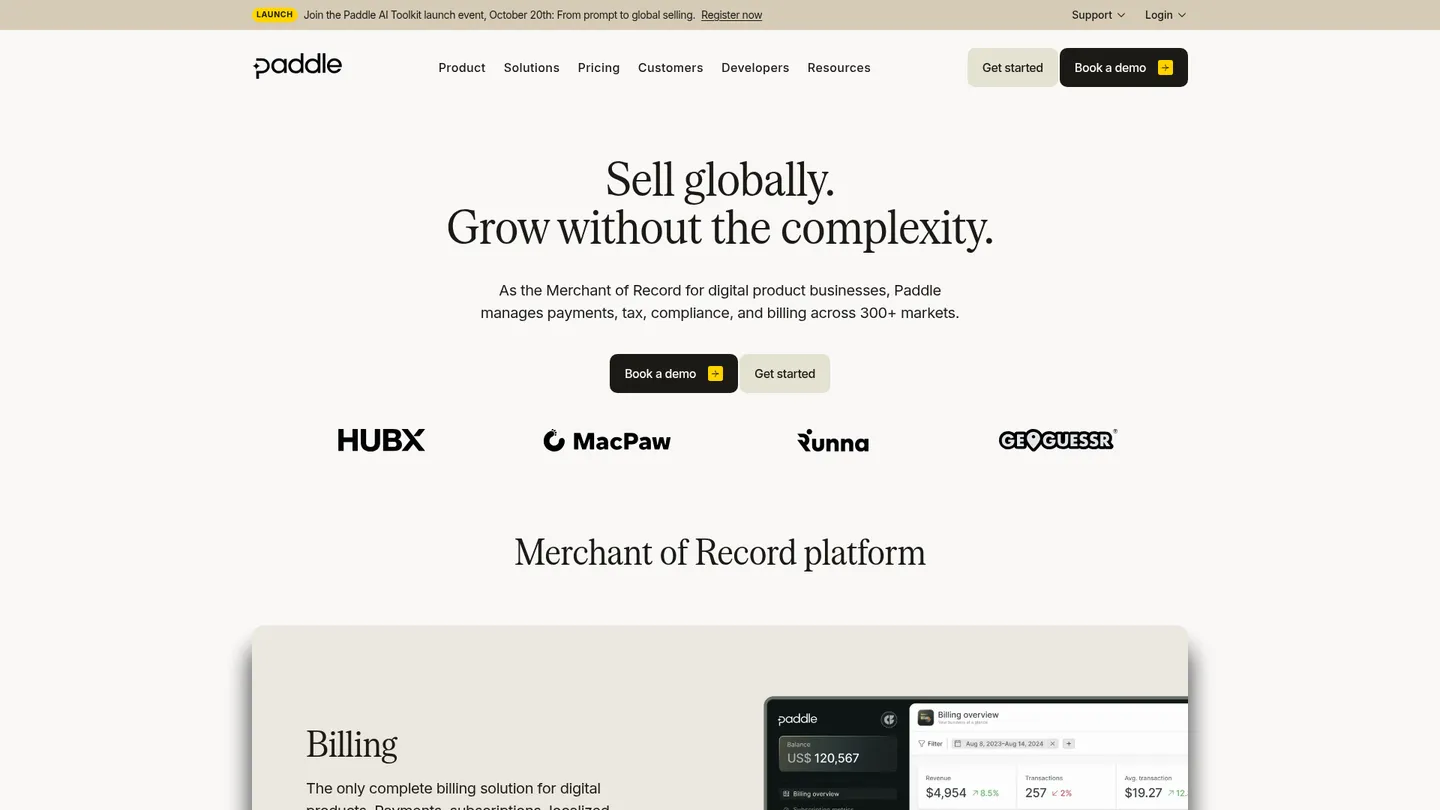
What is Paddle?
Founded in 2012, Paddle is a London-based merchant-of-record platform for software and SaaS companies. It combines checkout, payments, subscriptions, tax compliance, fraud protection, chargebacks, invoicing, and buyer support.
Paddle is a merchant-of-record platform for SaaS and digital products. Sellers configure products and prices, then connect hosted or embedded checkout through Paddle.js, APIs, and webhooks. Paddle processes transactions, manages subscriptions, calculates and remits taxes, and handles payment-related buyer support. This gives software companies one commercial layer for international payments, billing, tax, fraud, chargebacks, and customer operations instead of requiring several separate providers.
The platform covers localized pricing, one-time and recurring transactions, invoices, trials, discounts, customer portals, subscription pauses and cancellations, upgrades and downgrades, payment recovery, dunning, reporting, and retention workflows. Paddle provides APIs, webhooks, sandbox testing, Paddle.js, and official Node.js, Python, Go, and PHP SDKs. It is not a general-purpose ERP or accounting suite, and Paddle Billing is separate from the legacy Paddle Classic platform, with different APIs, identifiers, webhooks, and concepts.
Paddle is aimed at software publishers, SaaS companies, app businesses, and digital-product teams selling internationally. Its public pay-as-you-go price is 5% plus 50¢ per Checkout transaction, with no monthly, migration, or hidden fees; high-volume or low-value sellers can request custom pricing. The transaction fee includes payment processing, tax handling, fraud protection, chargebacks, billing infrastructure, and buyer support, while implementation requires account verification and technical integration.
Key features
Merchant of record
Acts as seller of record and handles payment management, tax calculation and remittance, fraud screening, chargebacks, and buyer support.
Subscription billing
Supports recurring prices, trials, pauses, cancellations, upgrades, downgrades, billing-date changes, and multi-item subscriptions.
Checkout and payments
Provides hosted, overlay, inline, and Paddle.js checkout with localized pricing and multiple payment workflows.
Tax compliance
Calculates, collects, and remits sales tax and VAT for sellers across 200+ countries on their behalf.
Revenue recovery
Provides dunning, payment recovery, cancellation flows, and retention tools through Paddle Retain.
Developer integration
Offers APIs, webhooks, sandbox testing, customer-portal links, Paddle.js, and Node.js, Python, Go, and PHP SDKs.
Invoicing and reporting
Supports manually collected invoices, transaction management, account data, reports, and buyer subscription self-service.
Paddle pricing
Paddle's public pay-as-you-go rate is 5% plus 50¢ per Checkout transaction, with no monthly, migration, or hidden fees. The fee covers payments, tax compliance, fraud, chargebacks, billing, and buyer support. High-volume or low-value transactions can receive custom pricing.
| Plan | Price | What's included |
|---|---|---|
| Pay-as-you-go | 5% + 50¢/transactionNo monthly, migration, or hidden fees | Payments, checkout, billing, global tax and regulatory compliance, fraud protection, chargebacks, and buyer support |
| Custom pricing | CustomFor high-volume businesses or more complex needs | Flexible pricing, dedicated customer success, premium services, and hands-on migration and launch support |
Free trial: Contact sales to discuss evaluation; sellers can test integrations in a sandbox.
Pros & cons
Pros
- Combines merchant-of-record tax responsibility with payments, billing, fraud, and chargeback handling.
- Publishes a straightforward pay-as-you-go rate with no monthly or migration fee.
- Provides APIs, webhooks, checkout components, sandbox testing, and four official server-side SDKs.
- Supports subscription recovery, customer portals, trials, discounts, and lifecycle changes.
Cons
- The 5% plus 50¢ blended fee can be expensive for high-volume or low-value transactions.
- Paddle Billing and legacy Paddle Classic use different APIs, IDs, webhooks, and concepts.
- Desktop SDKs are not available in the official SDK catalog.
- High-volume and low-value sellers need custom commercial discussions rather than a published rate.
Who is Paddle best for?
- SaaS companies selling subscriptions across multiple tax jurisdictions.
- Software publishers that want a merchant of record instead of managing payment entities themselves.
- Small revenue teams needing checkout, billing, tax, fraud, and buyer support in one platform.
- Digital-product businesses that need localized payments and subscription recovery without building the back office.
Coverage
Integrations
Frequently asked questions
How much does Paddle cost?
+
Paddle's public pay-as-you-go price is 5% plus 50¢ per Checkout transaction. There are no monthly, migration, or hidden fees; high-volume or low-value sellers can request custom pricing.
How does Paddle work, and how long does implementation take?
+
A seller configures products and prices, adds checkout or Paddle.js, connects API credentials and webhooks, and tests in the sandbox before going live. Paddle provides setup and go-live checklists, but does not publish a fixed implementation timeline.
How does Paddle compare with Stripe?
+
Paddle is a full merchant of record, while Stripe generally requires sellers to assemble more of their own tax, billing, fraud, and support stack unless they add managed products. Paddle advertises an all-in 5% plus 50¢ transaction price, whereas total Stripe cost depends on the products and services selected.
What integrations does Paddle support?
+
The core integration surface is Paddle's API, webhooks, Paddle.js, checkout, sandbox, customer portal, and official Node.js, Python, Go, and PHP SDKs. Paddle also supports connections to CRM, reporting, and business-intelligence systems through its APIs.
Who is Paddle for?
+
Paddle is designed for SaaS companies, software publishers, app businesses, and digital-product sellers operating internationally. It is most useful when a team wants Paddle to handle merchant-of-record payments, tax remittance, fraud, chargebacks, billing, and buyer support.
Is Paddle secure and accurate for tax and billing operations?
+
Paddle's merchant-of-record model covers tax calculation and remittance, fraud screening, chargebacks, and payment operations, while its integration model uses authenticated APIs and webhook events. Sellers should still test webhook handling, product configuration, refunds, and jurisdiction-specific outcomes before launch.
Sources
Facts and pricing verified on October 19, 2026. Vendors change pricing often, so confirm with Paddle before buying. How we research