
 OneTrust
 Optro
 Workiva
 MetricStream
 IBM OpenPages
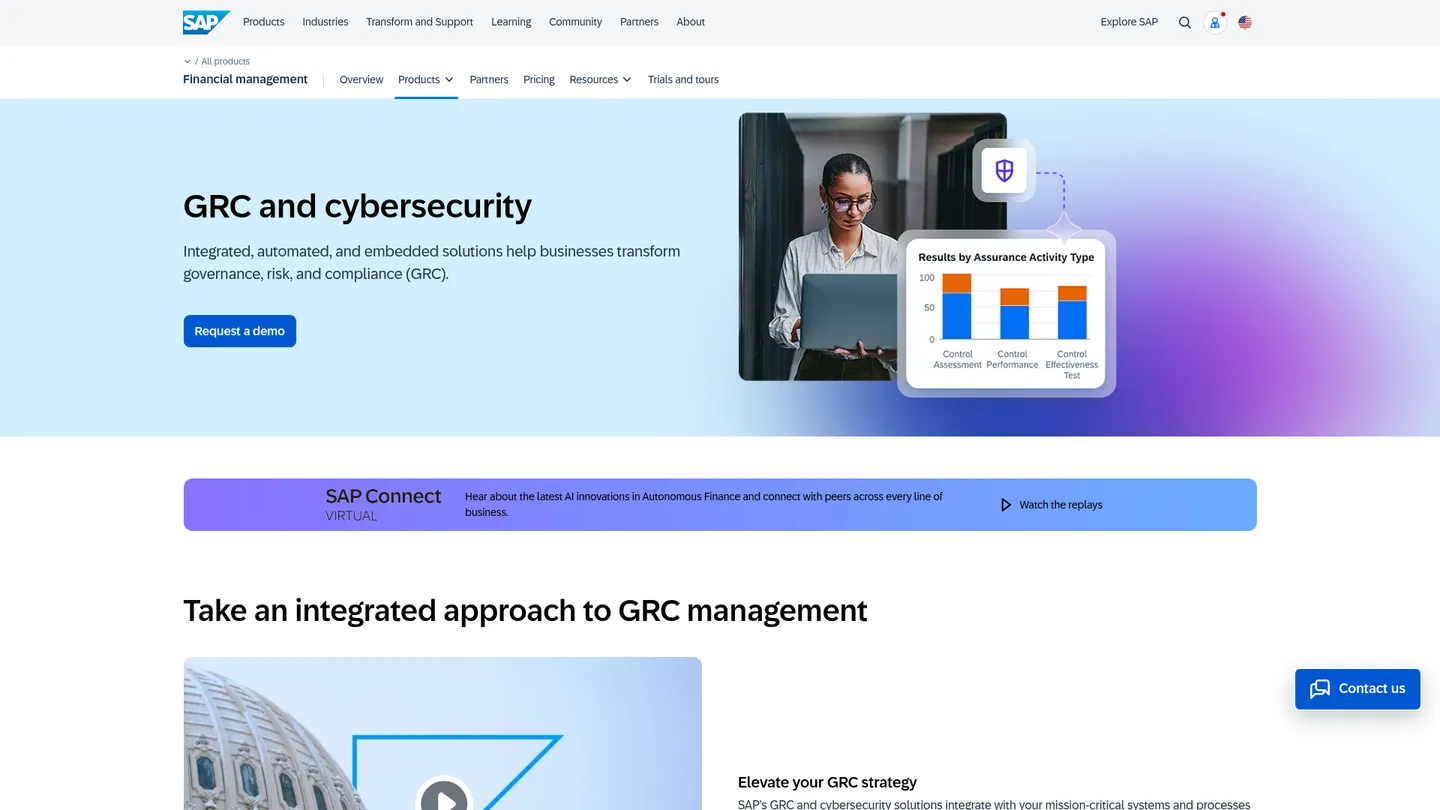
What is SAP GRC?
SAP GRC is a modular governance, risk, and compliance portfolio from SAP, founded in 1972 and headquartered in Walldorf, Germany. Its products support enterprise risk, controls, identity and access governance, cybersecurity, data protection, audit, and international trade.
SAP GRC is a portfolio of modular applications connecting governance, risk, and compliance work with business processes and SAP S/4HANA. Organizations can deploy capabilities on premises, in the cloud, or in hybrid landscapes. The portfolio covers enterprise risk and compliance, identity and access governance, cybersecurity and data protection, and international trade management. The suite is broader than SAP Access Control, which is one application within it.
The portfolio covers risk monitoring, internal controls, control testing, audit planning, evidence, access requests, provisioning, segregation-of-duties analysis, privileged access, threat monitoring, privacy, data protection, fraud screening, tax compliance, and global trade. Its main limitation is complexity: products are modular, additional licensing may apply, and buyers typically need SAP architecture, implementation, and integration expertise rather than a quick self-service deployment. This breadth requires careful configuration.
SAP GRC is best suited to larger enterprises already invested in SAP ERP or S/4HANA and needing centralized controls, risk, access, audit, or regulatory processes across business units. It is sold through SAP enterprise contracting rather than a simple public subscription price. SAP lists cloud offerings with term and usage metrics, while broader GRC products are generally priced by quote; implementation and partner services are separate considerations.
Key features
Enterprise risk management
Identify, assess, monitor, and report risks, indicators, incidents, and mitigation actions.
Controls and compliance
Document risks and controls, automate control processes, assess business impact, and support compliance reporting.
Identity and access governance
Provision access, manage roles, analyze access risk and segregation of duties, and support privileged access.
Audit management
Plan and manage audit engagements, assessments, evidence, reporting, and audit issues.
Cybersecurity and data protection
Monitor application threats and vulnerabilities and support security, privacy, masking, and encryption controls.
Fraud and integrity screening
Screen transactions and third parties, identify irregularities, and generate compliance documentation.
Trade and tax compliance
Support import and export processes, trade screening, tax determinations, calculations, and reporting.
SAP GRC pricing
SAP does not publish a single entry price for the SAP GRC portfolio. Cloud offerings are contracted by metrics such as resources, connections, or users and by terms of three to 60 months depending on the edition; SAP states that pricing is available on request. The portfolio can include additional licenses and implementation work.
| Plan | Price | What's included |
|---|---|---|
| SAP GRC portfolio | Custom quoteModular products and deployment options | Enterprise risk and compliance, identity and access governance, cybersecurity and data protection, international trade management, and related SAP applications |
| SAP Cloud Identity Access Governance, standard edition | Price upon requestCloud offering priced in blocks of 1,000 resources per year | One production tenant, one test tenant, and one SAP Business Technology Platform production tenant when required |
| SAP Cloud Identity Access Governance, integration edition | Price upon requestCloud offering priced per connection per year | Access risk analysis, user provisioning fulfillment, role management, one production tenant, and one test tenant |
Free trial: Request a product demonstration through SAP.
Pros & cons
Pros
- Connects GRC capabilities to SAP S/4HANA and core enterprise processes.
- Covers risk, controls, access, audit, cybersecurity, data protection, trade, and tax use cases.
- Supports on-premises, cloud, and hybrid deployment models.
- Offers specialized modules for different GRC requirements.
Cons
- The portfolio requires enterprise licensing and does not publish a simple starting price.
- Modular products and additional licenses can make scope and total cost difficult to estimate.
- Implementation requires substantial SAP landscape and integration expertise.
- The breadth and enterprise interface can be more complex than focused standalone GRC tools.
Who is SAP GRC best for?
- Large SAP-centric enterprises coordinating risk, controls, and audit across multiple business units.
- Finance and compliance teams embedding controls and risk data in SAP processes.
- Security and identity teams managing access risk, segregation of duties, and provisioning in SAP landscapes.
- Organizations requiring cloud, on-premises, or hybrid deployment across a broad GRC program.
Coverage
Integrations
Frequently asked questions
How much does SAP GRC cost?
+
SAP does not publish a universal SAP GRC starting price. Cloud editions are priced on request using metrics such as resources or connections and contract terms, while the broader portfolio may require separate product licenses and implementation services.
How does SAP GRC work and how long does implementation take?
+
SAP GRC combines modular applications with SAP business systems, using shared risk, control, access, audit, and compliance processes. Implementation time depends on selected modules, the SAP landscape, data and role cleanup, integrations, and organizational scope.
How is SAP GRC different from OneTrust?
+
SAP GRC is designed for deep integration with SAP S/4HANA and SAP enterprise processes, with modules spanning access, controls, risk, audit, security, trade, and tax. OneTrust is a listed alternative, while the choice depends on SAP-system depth, privacy scope, and operating model.
What does SAP GRC integrate with?
+
Documented integrations include SAP S/4HANA, SAP ERP, SAP Cloud Identity Access Governance, SAP SuccessFactors Employee Central, SAP Enterprise Portal, SAP Fiori, SAP NetWeaver, and SAP HANA. SAP Access Control also supports connector and plug-in scenarios for ERP, HANA, portals, and identity-management systems.
Who should buy SAP GRC?
+
It is aimed primarily at larger organizations that run SAP and need coordinated enterprise risk, controls, access governance, audit, cybersecurity, trade, or tax compliance. Smaller teams seeking a quick standalone compliance checklist tool are less likely to need the full portfolio.
Is SAP GRC secure and accurate for compliance work?
+
SAP GRC provides workflows, monitoring, risk analysis, control testing, audit evidence, and reporting, but software does not establish compliance by itself. Accuracy depends on configured rules, integrations, master data, roles, control design, and ongoing review by qualified personnel.
Sources
Facts and pricing verified on October 19, 2026. Vendors change pricing often, so confirm with SAP GRC before buying. How we research