 OneTrust
 Whistic
 Archer
 Optro
 Workiva
What is Zip?
Founded in 2020 and headquartered in San Francisco, Zip provides procurement orchestration for enterprise organizations. It has raised $371 million and connects purchasing requests with supplier, risk, contract and payment workflows.
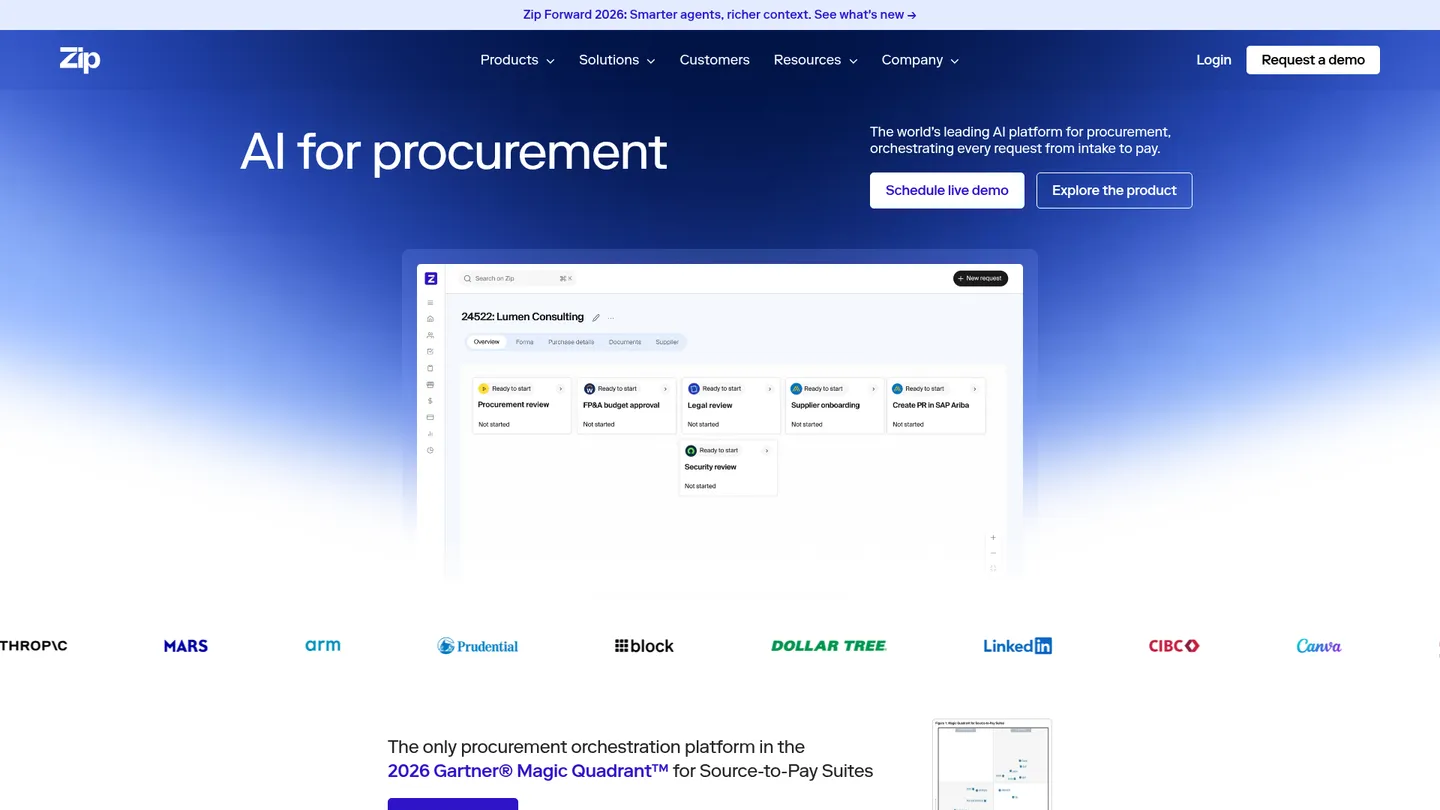
Zip is a cloud procurement platform that gives employees one entry point for purchase, supplier and contract requests. Configurable forms collect required information, then route each request through policy-based approvals involving procurement, finance, legal, IT, security and risk teams. The platform connects intake with sourcing, supplier onboarding, purchase orders, invoices, payments and downstream business systems. This keeps cross-functional reviews attached to the same purchasing record.
Its scope covers intake-to-procure, procure-to-pay, sourcing, supplier management, risk orchestration, contract orchestration, spend insights and global payments. Zip works primarily as an orchestration layer over an existing enterprise stack rather than a replacement for every specialist system. Advanced contract, risk, analytics and payment requirements may depend on integrations or separately scoped modules. Buyers can therefore retain specialist tools while coordinating their reviews through Zip.
Zip targets complex, distributed procurement operations, especially global and Global 2000 organizations managing indirect spend, technology, services and regulated supplier relationships. Pricing is quote-based and generally structured as an annual enterprise license, with scope influenced by employees, users, modules and integrations. Vendr lists a $26,586 annual low and $88,000 median, alongside a $75,000 AWS Marketplace pilot for 100 active users and one workflow.
Key features
Request intake
Provides a single entry point for purchase, supplier, contract and other business requests.
Approval workflows
Uses no-code, conditional workflows to route requests to the appropriate approvers and reviewers.
Supplier onboarding
Collects supplier identity, tax, banking and compliance information through a guided portal.
Procure-to-pay
Connects approved requests with purchase orders, invoice processing, coding and payment workflows.
Risk orchestration
Coordinates third-party risk reviews and related compliance checks within procurement workflows.
Contract orchestration
Extracts contract metadata and flags deviations from organizational playbooks, with broader CLM integrations available.
Global payments
Supports vendor payments across 140+ countries and 40+ currencies.
Zip pricing
Zip does not publish standard list pricing. Vendr lists a $26,586 low and $88,000 median annual contract across 75 purchases, while AWS Marketplace lists a $75,000 annual pilot for 100 active users and one workflow. These are procurement benchmarks rather than published vendor tiers.
| Plan | Price | What's included |
|---|---|---|
| Pilot | $75,000/yearAWS Marketplace benchmark | 100 active users, 1 workflow |
| Enterprise subscription | Custom | Procurement intake, configurable approvals, supplier workflows, modules scoped by agreement |
Free trial: No public free trial is listed.
Pros & cons
Pros
- One intake layer connects procurement, legal, security, finance and risk reviews.
- No-code workflow configuration supports complex approval paths and changing policies.
- Broad integration coverage allows Zip to sit above existing ERP, S2P, CLM and GRC systems.
- Supplier, purchase order, invoice and payment records create a stronger audit trail than email-based processes.
Cons
- Pricing is custom and public benchmarks place the platform in an enterprise budget range.
- Advanced capabilities can require separate modules, implementation work or specialist integrations.
- Organizations with highly tailored reporting needs may need additional configuration or data exports.
- Zip adds an orchestration layer, so buyers must plan carefully for ownership of duplicate master data and workflows.
Who is Zip best for?
- Global procurement teams coordinating complex, cross-functional approvals.
- Finance and compliance teams that need earlier visibility into committed spend.
- Organizations modernizing fragmented intake-to-pay processes without replacing every back-end system.
- Businesses managing supplier reviews, contracts and payments across multiple jurisdictions.
Coverage
Integrations
Notable customers
Frequently asked questions
How much does Zip cost?
+
Zip uses custom annual pricing rather than public tiers. Vendr lists a $26,586 low and $88,000 median annual Zip HQ contract, while AWS Marketplace lists a $75,000 annual pilot for 100 active users and one workflow.
How long does Zip take to implement?
+
The typical implementation takes 9–12 weeks, depending on process redesign and integration complexity. Some customer deployments have gone live in under eight weeks, while broader enterprise programs can require more planning.
How does Zip compare with OneTrust?
+
Zip is primarily a procurement orchestration and intake-to-pay platform, while OneTrust is primarily a privacy, governance, risk and compliance platform. Zip can route supplier risk work and integrate with OneTrust, but it is not a direct replacement for OneTrust's wider compliance suite.
Which systems integrate with Zip?
+
Documented integrations include NetSuite, SAP Ariba, Coupa, Workday, ServiceNow, Slack, DocuSign and Ironclad. Zip also offers APIs, an integration platform, CSV exports and more than 50 out-of-the-box connectors.
Who is Zip for?
+
Zip is aimed at mid-market and enterprise procurement, finance, legal, IT, security and compliance teams. It suits organizations with distributed purchasing, complex approvals, fragmented systems and significant indirect spend.
How does Zip support security, compliance and accuracy?
+
Zip provides workflow audit logs, permission controls, supplier data collection and Zip Premier features for granular data privacy and audit controls. Its AI can extract contract and invoice information, but generated outputs should be reviewed for critical procurement, compliance and payment decisions.
Sources
Facts and pricing verified on October 19, 2026. Vendors change pricing often, so confirm with Zip before buying. How we research