 Vanta
 Drata
 Alloy
 Hummingbird
 ComplyAdvantage
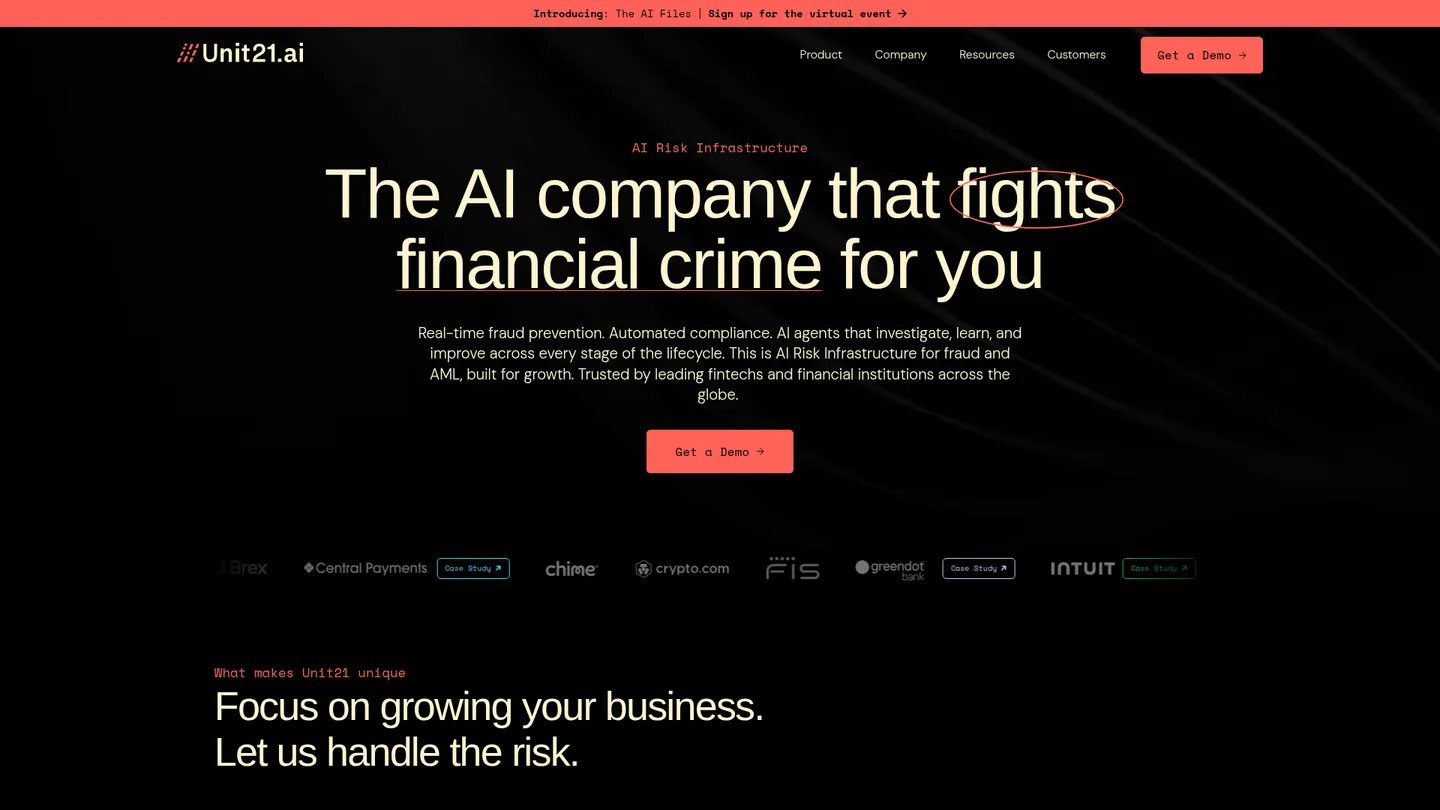
What is Unit21?
Founded in 2018 and headquartered in San Francisco, Unit21 provides configurable AML, fraud, case-management, and regulatory-filing software. Its customers include financial institutions and fintechs such as Green Dot, Intuit, and MoonPay.
Unit21 is a cloud platform for financial-crime operations. Customers send transaction, customer, behavioral, device, and external risk data through APIs or file ingestion, then configure detection rules and AI models to score activity, generate alerts, and route work. Investigators use a shared workbench to connect entities, review supporting evidence, document decisions, and escalate cases. Historical backtesting and shadow mode let teams test rules before production, while real-time monitoring supports payment and account-risk workflows.
The product spans transaction monitoring, fraud detection, customer risk scoring, case management, sanctions and payment screening, KYC and KYB orchestration, and regulatory filing. Teams can configure rules, workflows, permissions, deduplication, and alert prioritization without writing SQL or application code. It also supports AI detection and investigation agents, but public materials do not provide independent recall, false-negative, or model-validation metrics; buyers should validate performance against their own historical data and regulatory program.
Unit21 sells to banks, fintechs, payments companies, cryptocurrency businesses, and other regulated financial institutions. Public customer examples include Green Dot, Intuit, MoonPay, PrizePicks, and Dave, with case studies reporting faster investigations and large-scale transaction processing. Pricing is quote-based and varies by data volume, modules, and deployment scope. Vendr reports observed annual contracts from about $33,000 to $740,000, with an average around $160,000; Unit21 does not publish a self-serve tier or rate card.
Key features
Transaction monitoring
Monitors transaction and behavioral data in real time with configurable rules, AI detection, risk scoring, and alert workflows.
Fraud detection
Combines transaction, device, customer, and external signals to identify fraud patterns and prioritize suspicious activity.
Case management
Connects alerts, entities, evidence, tasks, permissions, and investigator decisions in a shared operations workbench.
Regulatory filing
Supports preparation and workflow for SAR, CTR, STR, 314(a), and goAML filings, with validation and audit trails.
KYC and KYB
Orchestrates identity and business-verification signals from integrated providers into monitoring and investigations.
Sanctions screening
Supports sanctions, PEP, adverse-media, and payment screening through native and connected intelligence sources.
AI risk agents
Uses detection and investigation agents to recommend risk insights, triage alerts, gather evidence, and draft narratives.
Unit21 pricing
Unit21 publishes no rate card, free plan, or self-serve checkout. Vendr buyer-transaction data reports contracts from approximately $33,000 to $740,000 annually, with an average near $160,000. Actual pricing depends on transaction volume, modules, analyst scope, integrations, and implementation requirements.
| Plan | Price | What's included |
|---|---|---|
| Custom | Quote-based | Transaction monitoring, fraud detection, case management, regulatory filing, screening, integrations, configurable rules, and implementation scope are tailored to the customer. |
Free trial: No public free trial; contact sales for a quote.
Pros & cons
Pros
- No-code configuration lets compliance teams create, test, and deploy rules and workflows.
- The platform combines monitoring, investigations, case management, and filings rather than requiring separate workbenches.
- Native and connected data sources cover core banking, identity, crypto analytics, warehouses, and CRM systems.
- Backtesting and shadow mode provide a practical way to validate detection changes before release.
Cons
- Pricing is not published and requires an enterprise sales process.
- Implementation and data integration can require substantial customer-specific work.
- Public materials do not provide independent recall, false-negative, or model-validation metrics.
- Some reviewers report that complex rules, custom-field search, and parts of the interface can be difficult to use.
Who is Unit21 best for?
- Banks and fintechs that need configurable AML monitoring across high-volume transaction data.
- Compliance teams that want no-code rule and workflow changes without engineering tickets.
- Crypto businesses that need blockchain intelligence connected to investigations and reporting.
- Regulated institutions consolidating alerts, investigations, and filings in one operational workspace.
Coverage
Integrations
Notable customers
Frequently asked questions
How much does Unit21 cost?
+
Unit21 uses custom, quote-based pricing and publishes no rate card. Vendr reports observed annual contracts of about $33,000–$740,000, with an average near $160,000; the quote depends on volume, modules, integrations, and scope.
How long does Unit21 take to implement, and how does it work?
+
Implementation depends on data readiness, integrations, rules, and regulatory workflows. Green Dot says it went from contract to go-live in seven months while processing more than 3.6 billion transactions annually; Unit21 supports backtesting and shadow mode before production.
How does Unit21 compare with Alloy?
+
Unit21 centers on ongoing AML and fraud monitoring, investigations, and regulatory filing across transaction and behavioral data. Alloy is a close alternative for identity, onboarding, and fraud decisioning, so buyers should compare filing depth, case operations, data integrations, and implementation work.
What integrations does Unit21 support?
+
Unit21 says its ingestion technology can connect with any tool, provider, or system. Named examples include Chainalysis, Elliptic, TRM Labs, Persona, Socure, Trulioo, Snowflake, BigQuery, Databricks, core-banking platforms, and Salesforce.
Who is Unit21 for?
+
It is designed for banks, fintechs, payments companies, cryptocurrency businesses, and other regulated financial institutions. It suits teams that need configurable monitoring and investigations but want compliance operators—not engineers—to manage rules and workflows.
How secure and accurate is Unit21?
+
Unit21 publishes security information including SOC 2 Type I and Type II reports, encryption, MFA, audit logging, and penetration testing. Its public materials describe AI and backtesting, but do not publish independent recall or false-negative benchmarks, so buyers should test accuracy using representative historical data.
Sources
Facts and pricing verified on October 19, 2026. Vendors change pricing often, so confirm with Unit21 before buying. How we research