 OneTrust
 Holistic AI
 Asenion
 RegScale
 Trustible
What is Credo AI?
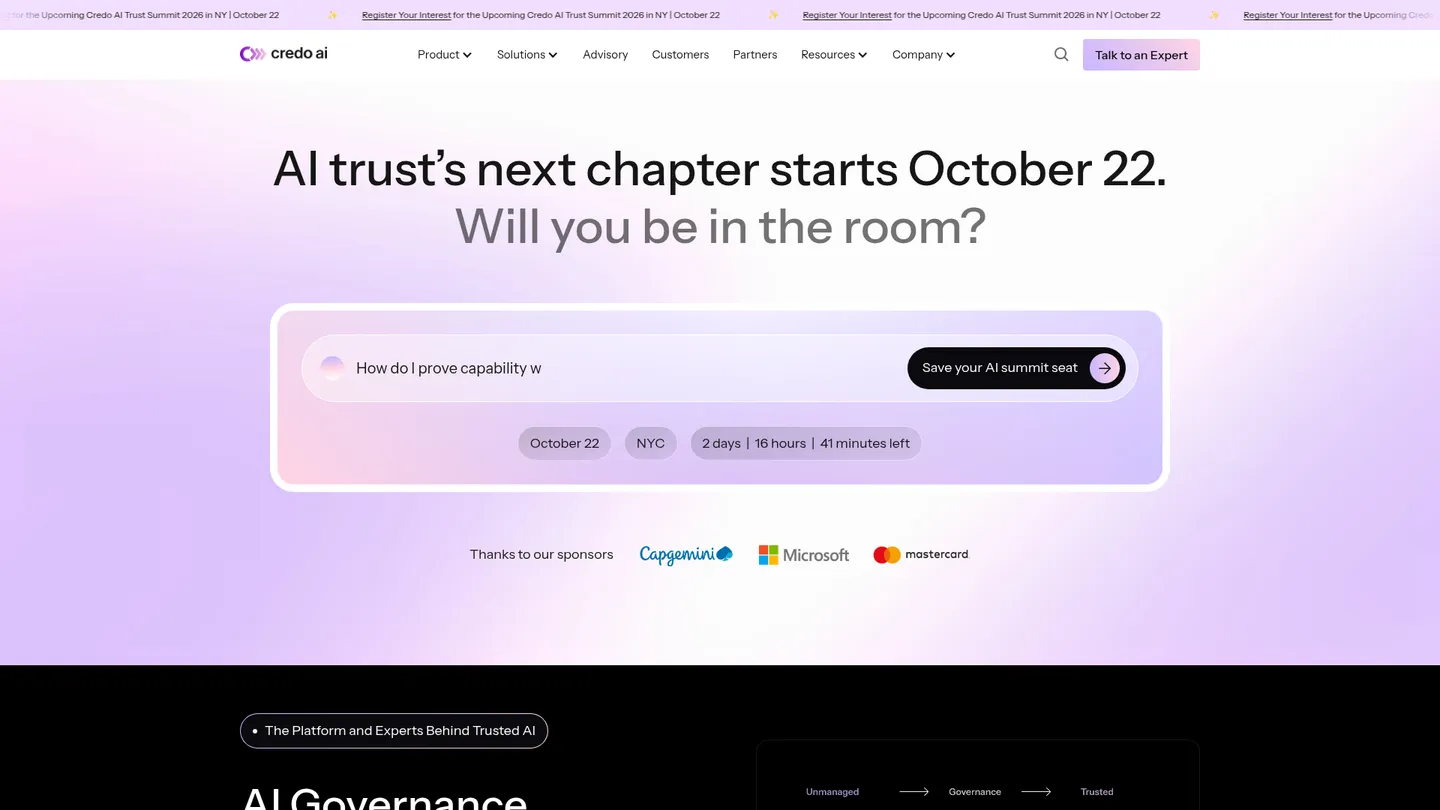
Founded in 2020 and headquartered in Palo Alto, California, Credo AI provides enterprise software for governing models, applications, agents and AI vendors. The company reported $41.3 million in total funding after a $21 million 2024 round.
Credo AI is an enterprise AI-governance platform that creates a central inventory of models, applications, agents and third-party AI vendors, then connects each system to business context, regulatory requirements and controls. Its knowledge graph combines regulatory intelligence with an organization’s AI configuration, while workflows help technical, legal, risk and compliance stakeholders assess systems, assign ownership and document decisions. GAIA, its governance assistant, retrieves evidence, supports risk assessment, creates governance plans and helps remediate incidents while retaining human approval for critical decisions.
The platform spans AI discovery and registry, shadow-AI detection, dependency mapping, contextual risk assessment, policy-to-control mapping, compliance monitoring, audit evidence and governance reporting. It offers policy packs for the EU AI Act, NIST AI RMF, ISO/IEC 42001 and SOC 2, plus custom taxonomies and workflows. Its breadth is strongest around inventory, policy and evidence operations; buyers needing deep per-request observability, automated behavioral testing or hard runtime enforcement should validate the relevant integrations and retain specialized controls where necessary.
Credo AI is aimed at larger, regulated organizations coordinating AI governance across legal, compliance, risk, security, data science and product teams. Public materials name customers and partners including Mastercard, Northrop Grumman, Booz Allen Hamilton and Databricks. Pricing is enterprise, annual and quote-based, with AWS Marketplace packaging priced privately by the number of AI use cases under management; the marketplace’s $1.00 figure is a placeholder rather than a usable list price. No free plan or public self-serve tier is verified.
Key features
AI registry and discovery
Catalogs models, applications, agents and vendors, including shadow AI, with ownership, classification and dependency visibility.
Risk intelligence
Assesses AI systems across technical, functional and agentic risk dimensions with contextual controls, scoring and continuous risk workflows.
Policy and compliance engine
Maps AI systems to regulatory requirements and controls using policy packs for the EU AI Act, NIST AI RMF, ISO/IEC 42001 and SOC 2.
Governance workflows
Routes assessments, approvals, evidence collection and remediation across technical and non-technical stakeholders with audit trails.
Continuous monitoring
Ingests traces and evaluation signals to monitor policy violations, drift and unsafe behavior, with alerts and human escalation workflows.
Audit evidence and reporting
Generates compliance artifacts, control evidence and governance reports for internal review and external audit readiness.
Governance AI assistant
GAIA retrieves evidence, assesses risk, drafts governance plans and supports remediation of recurring governance tasks.
Credo AI pricing
Credo AI uses custom annual contracts. AWS Marketplace offers an Enterprise Plan through private offers, with scope based on governed AI use cases; its nominal $1 listing is not a usable platform starting price. Microsoft Marketplace also directs buyers to sales.
| Plan | Price | What's included |
|---|---|---|
| Enterprise Plan | CustomAWS Marketplace annual subscription; private offer required | AI Registry and other modules selected through the private offer, with expansion to risk intelligence, compliance and runtime governance as needed |
Free trial: No free trial or free plan is publicly listed.
Pros & cons
Pros
- Combines registry, risk, policy mapping and evidence workflows in one AI-specific governance platform.
- Policy packs cover major emerging AI governance frameworks, including the EU AI Act and ISO/IEC 42001.
- Broad integrations connect governance work to cloud, MLOps, GRC and business systems.
- Use-case-based enterprise packaging can expand as an organization’s governed AI inventory grows.
Cons
- Pricing is private and use-case-based, making early budget estimation difficult.
- Implementation and workflow configuration can require substantial cross-functional effort.
- Organizations may still need specialized tools for deep behavioral testing or low-level runtime enforcement.
- Public independent review volume remains small compared with established GRC platforms.
Who is Credo AI best for?
- Large enterprises building a centralized inventory of models, agents, applications and AI vendors.
- Regulated organizations mapping AI systems to the EU AI Act, NIST AI RMF or ISO/IEC 42001.
- Cross-functional governance teams that need shared assessments, approvals, evidence and audit trails.
- Companies that want AI governance embedded in existing cloud, MLOps, GRC and ticketing workflows.
Frameworks and use cases
Integrations
Notable customers
Frequently asked questions
How much does Credo AI cost?
+
Credo AI uses annual enterprise contracts with custom pricing. AWS Marketplace says the subscription is priced privately according to the number of AI use cases under management, and Microsoft Marketplace likewise directs buyers to sales.
How does Credo AI work?
+
Teams register models, applications, agents and vendors, classify their risks, map them to policies and controls, and run approval and evidence workflows. Integrations can import systems, models, datasets and evidence from existing cloud, MLOps, GRC and business tools.
How does Credo AI compare with OneTrust?
+
Credo AI is purpose-built around AI systems, agents, models, vendors and AI-specific regulatory controls. OneTrust is a broader privacy, risk and trust suite, so buyers should compare required AI governance depth, existing ecosystem fit and deployment scope.
What integrations does Credo AI support?
+
Named integrations include AWS, Azure, Snowflake, Databricks, ServiceNow, Jira, GitHub and MLflow. The integrations hub also lists tools such as SageMaker, Bedrock, Salesforce, Asana, Azure Machine Learning, Weights & Biases, Hugging Face and Collibra.
Who is Credo AI for?
+
It is designed for enterprise governance programs involving legal, compliance, risk, security, data science, product and engineering stakeholders. It is particularly relevant to regulated organizations managing multiple AI use cases across business units and jurisdictions.
Does Credo AI provide security and accuracy controls?
+
Credo AI provides risk assessment, policy controls, audit trails, compliance evidence and monitoring workflows, including human escalation. Buyers should validate coverage for their specific runtime security, red-team testing, accuracy and observability requirements because those may depend on integrations or complementary tools.
Sources
Facts and pricing verified on October 19, 2026. Vendors change pricing often, so confirm with Credo AI before buying. How we research