
 OneTrust
 Transcend
 TrustArc
 Ketch
 BigID
What is DataGrail?
DataGrail is a data privacy platform founded by Daniel Barber and Ignacio Zendejas, headquartered in San Francisco. Its platform connects more than 2,000 systems to automate privacy operations for mid-market and enterprise brands.
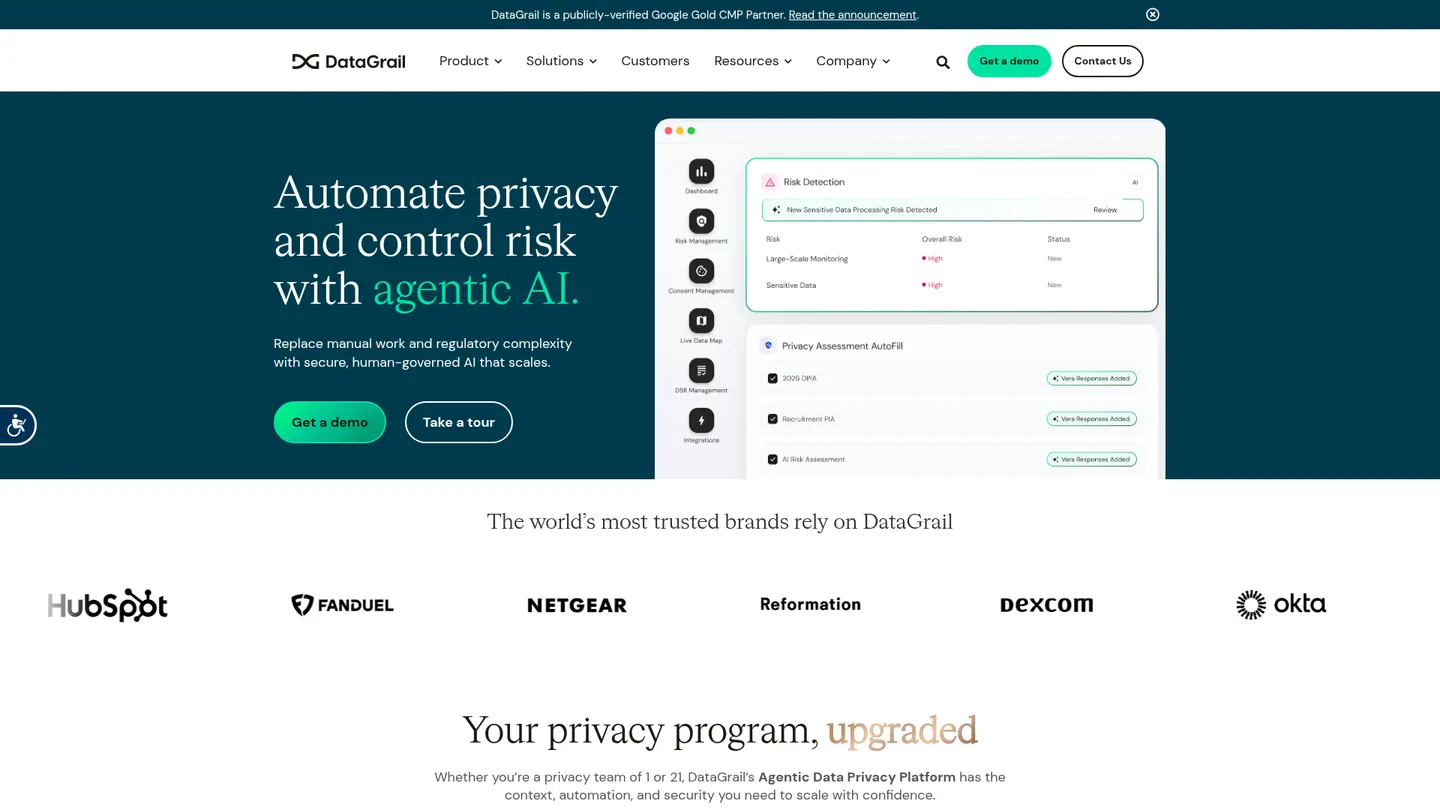
DataGrail centralizes privacy operations in a platform that discovers systems holding personal information, maps data flows and coordinates actions across connected applications. Its Request Manager automates access and deletion requests, while Live Data Map maintains an inventory of systems and processing activities. Consent tools monitor trackers and enforce preferences across websites, and Risk Assessments supports DPIAs, PIAs and related reviews. The platform also includes workflow automation, APIs, webhooks, role-based access and audit logging.
The product covers four practical areas: discovery and mapping, data-subject request management, consent management, and privacy risk assessment. Its integration network connects more than 2,000 applications, including SaaS tools, cloud stores and internal systems, and its API supports custom connections. DataGrail also offers responsible data discovery and an AI agent called Vera with human-approved actions. Buyers should expect implementation work for complex internal systems; public materials do not provide a self-serve free tier or transparent list pricing.
DataGrail is aimed at privacy, legal, security and compliance teams managing consumer or employee data across a large application estate. Public customer examples include Salesforce, New Balance, Instacart, Life360, Okta, MLS and GoFundMe, spanning technology, sports, retail and consumer services. Contracts are quote-based and can be purchased as a full Privacy Control Center or as individual modules, with optional managed DSR and consulting services. A HubSpot marketplace listing shows an Essentials deployment at $36,000, while Vendr reports a $50,000 median annual buyer contract across 73 purchases.
Key features
Live data mapping
Maintains a system inventory, detects new applications and identifies personal information across connected sources.
DSR automation
Automates access, deletion and other data-subject requests across third-party and internal systems.
Consent management
Monitors trackers and manages configurable consent banners, preferences and Google Tag Manager deployments.
Privacy assessments
Centralizes and auto-populates DPIAs, PIAs and assessments for GDPR, CCPA, CPRA and AI regulations.
Risk intelligence
Uses discovery and classification to surface privacy risk, shadow IT and changes in the application environment.
Workflow automation
Supports configurable workflows, APIs, webhooks, RBAC and audit logs for governed privacy operations.
AI privacy agent
Vera provides context-aware recommendations and approved actions while keeping human control and auditability.
DataGrail pricing
DataGrail does not publish standard list pricing; packaging varies by data-subject volume, request volume, integrations and modules. A HubSpot marketplace listing shows $36,000 for an Essentials deployment covering Live Data Map, automated requests, 900-plus integrations and up to 1 million unique identities. Vendr reports a $50,000 median annual contract from 73 purchases, with observed contracts from $20,000 to $365,500.
| Plan | Price | What's included |
|---|---|---|
| Essentials | $36,000/yr benchmarkHubSpot Marketplace listing | Live Data Map, automated data-subject requests, 900-plus integrations, up to 1 million unique identities |
| Privacy Control Center | Custom | End-to-end privacy and compliance management across DataGrail modules |
| Module deployment | Custom | Individual privacy modules such as Request Manager, Consent, Live Data Map or Risk Assessments |
| Managed services | Custom | Managed DSR fulfillment and technical privacy program consulting |
Free trial: Contact sales for a demonstration.
Pros & cons
Pros
- More than 2,000 integrations cover common SaaS, cloud and internal-system connections.
- The platform combines data mapping, DSRs, consent and assessments rather than requiring separate point tools.
- Customers can choose a full platform or individual modules and add managed DSR services.
- Security controls include AES-256 encryption, customer-provisioned cloud storage, SSO and audit logging.
Cons
- Pricing is quote-based, with no public standard tier table or self-serve trial.
- The broad integration and workflow scope can require implementation work for proprietary systems.
- G2 reviewers cite integration difficulties and limits on customizing some features.
- The product is designed for privacy programs and may be more infrastructure than a small company needs.
Who is DataGrail best for?
- Privacy teams that need automated access and deletion requests across a large SaaS estate.
- Legal and security groups building a continuously updated data map instead of a spreadsheet inventory.
- Consumer brands that need consent enforcement and privacy workflows across multiple websites.
- Mid-market and enterprise organizations that want managed privacy services alongside software.
Frameworks and coverage
Integrations
Notable customers
Frequently asked questions
How much does DataGrail cost?
+
DataGrail uses quote-based annual contracts. A HubSpot Marketplace listing shows $36,000 for an Essentials deployment, while Vendr reports a $50,000 median annual buyer contract across 73 purchases.
How long does DataGrail take to implement?
+
Implementation depends on the number of systems, workflows and modules. DataGrail customer material says Okta launched in two weeks, while complex internal systems can require API or custom integration work.
How does DataGrail compare with OneTrust?
+
Both cover broad privacy operations, but DataGrail emphasizes connected-system discovery, automated requests, consent and configurable workflows. DataGrail customer material specifically describes Labster moving away from OneTrust because of workflow and application-visibility issues; buyers should test both against their integration requirements.
Which integrations does DataGrail support?
+
DataGrail says its network exceeds 2,000 technology partners. Named examples include Salesforce, Okta, Atlassian, HubSpot, Zendesk, Google Analytics, Twilio and cloud storage systems.
Who is DataGrail for?
+
The platform is built for privacy, legal, security and compliance teams at mid-market and enterprise organizations. Its customer examples include Life360, Okta, MLS, Salesforce, Instacart and New Balance.
Is DataGrail secure and accurate?
+
DataGrail says customer data is encrypted at rest with AES-256 and in transit with TLS 1.2, with SSO, customer-provisioned storage and regular penetration tests. Its discovery and classification tools are intended to keep maps current, while audit logs and human approval controls help review automated actions.
Sources
Facts and pricing verified on October 19, 2026. Vendors change pricing often, so confirm with DataGrail before buying. How we research