
 OneTrust
 Transcend
 DataGrail
 BigID
 TrustArc
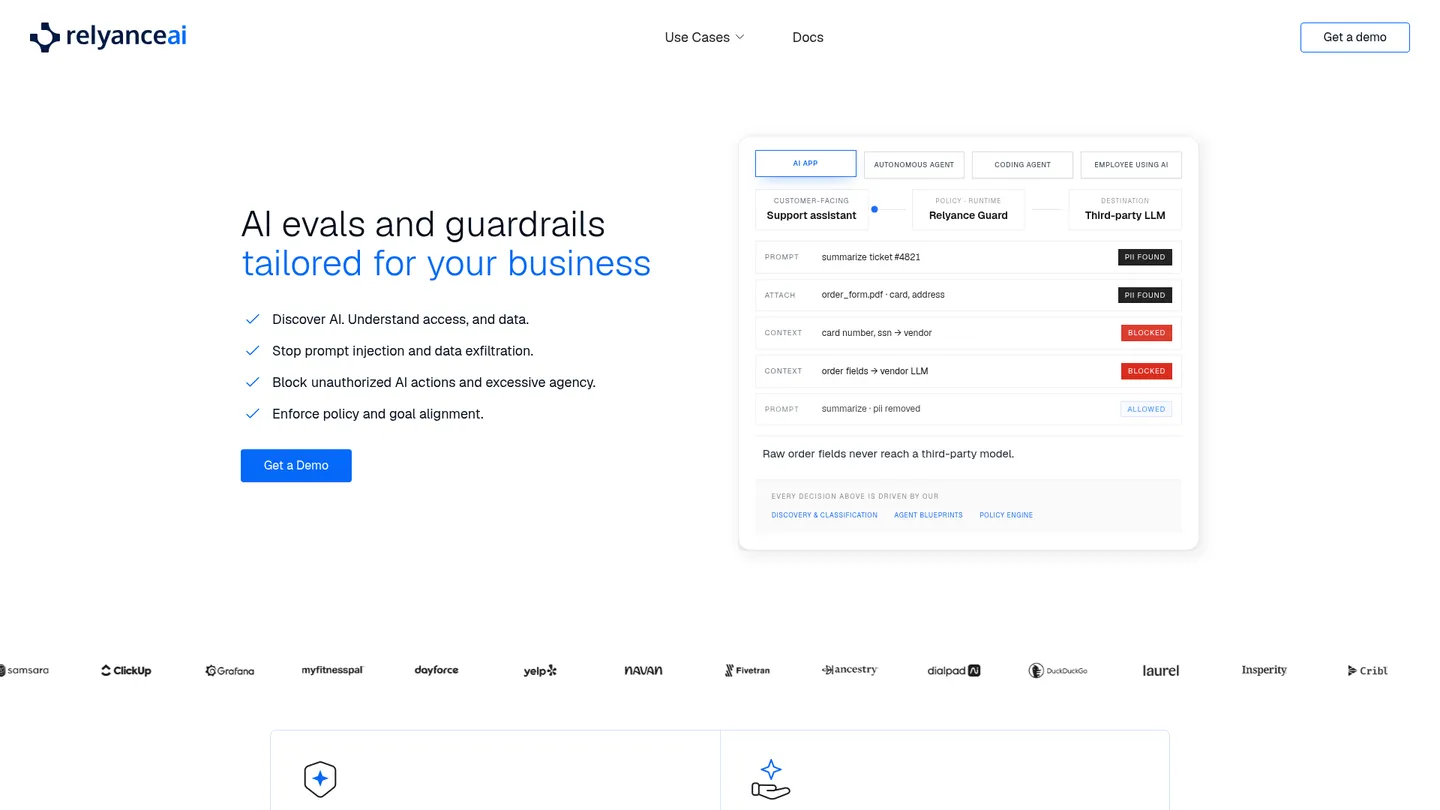
What is Relyance AI?
Headquartered in San Francisco, Relyance AI provides an AI-native platform for mapping, governing and protecting enterprise data. Publicly named customers include Coinbase, Fivetran, Verkada, Snowflake, Logitech, Plaid and Notion.
Relyance AI maps data journeys across source code, cloud infrastructure, data stores, identity systems, SaaS and AI providers, then connects sensitivity, permissions and processing context in one model. Its agentless integrations feed a data exposure graph that supports discovery, classification, vendor mapping, assessments, records of processing, data-subject requests and policy enforcement. The platform also checks AI prompts, agent actions and data destinations against organizational rules, allowing teams to block unsafe transfers while preserving approved work.
The product spans data security posture management, privacy operations and AI governance rather than a single-purpose privacy workflow. Core coverage includes data-store and vendor inventories, automated risk assessments, regulatory and contractual controls, data-flow analysis, AI discovery, shadow-AI detection, runtime guardrails, Universal RoPAs, DSR automation, consent management and optional source-code analysis. Buyers should validate connector coverage, classifier quality and prioritization during a proof of concept; G2’s five-review sample is small and includes criticism about risk classification.
Relyance AI is aimed at enterprise privacy, security, legal and compliance teams that need shared visibility across modern data estates and AI use. The vendor offers managed SaaS, an in-customer-cloud Outpost deployment and private DirectConnect connectivity. Privacy Essentials advertises implementation in hours, while a qualifying AI Governance Expert trial offers 30 days at no cost. Production pricing is quote-based across Data Security, AI Governance and Privacy Experts; Vendr reports a $60,000 median annual contract, not an official list price.
Key features
Data mapping
Maps data stores, vendors, code, cloud systems and processing flows into a connected inventory.
Sensitive data discovery
Classifies sensitive data and links it to regulatory, business-purpose and subject context.
AI governance
Discovers AI systems and shadow AI, assesses model risk and applies runtime policies to prompts and agent actions.
Privacy operations
Supports living RoPAs, automated assessments, DSR fulfillment, consent management and audit logging.
Risk monitoring
Prioritizes risk signals and provides dashboards, recommendations and compliance reporting.
Data security controls
Uses data, identity and AI context to block unauthorized access, transfers and actions.
Relyance AI pricing
Relyance AI publishes packaging and capabilities but not paid list prices. Its experts are offered in Essentials and Advanced tiers, with privacy add-ons such as Universal RoPAs, DSR automation and consent management. Vendr reports a $60,000 median annual contract and a $30,667–$109,807 observed range; these are third-party benchmarks, not official prices.
| Plan | Price | What's included |
|---|---|---|
| Privacy Essentials | Custom | Data mapping, automated assessments and unified obligations, with Universal RoPAs, DSR automation, consent management and source-code analysis available as add-ons. |
| Essentials | Custom | Core capabilities for the selected Data Security, AI Governance or Privacy Expert. |
| Advanced | Custom | Expanded capabilities for the selected Expert, including advanced risk, governance or privacy features as scoped in the quote. |
Free trial: Qualifying organizations can receive a 30-day AI Governance Expert trial; Privacy Essentials has no published numeric free plan.
Pros & cons
Pros
- Connects privacy, data security and AI governance to a shared data model.
- Agentless connectors cover code, cloud, data platforms, identity, SaaS and AI providers.
- Privacy Essentials advertises deployment in hours rather than lengthy implementation projects.
- Supports SaaS, customer-cloud and private-connectivity deployment models.
Cons
- Public paid pricing and implementation fees are not disclosed.
- Meaningful coverage depends on engineering access to connected systems and repositories.
- G2 has only five reviews, limiting the reliability of its 3.9/5 average.
- Review feedback flags learning-curve, integration and risk-prioritization concerns.
Who is Relyance AI best for?
- Enterprise privacy teams needing a living data map across code, cloud, SaaS and AI systems.
- Security and compliance leaders governing shadow AI and agent access to sensitive data.
- Organizations replacing spreadsheet-based RoPAs, assessments and vendor inventories.
- Companies able to provide engineering access to repositories, cloud services and business systems.
Coverage
Integrations
Notable customers
Frequently asked questions
How much does Relyance AI cost?
+
Paid plans are quote-based, and the vendor does not publish numeric list prices. Vendr reports a $60,000 median annual contract; that is a third-party benchmark rather than a rate card.
How long does implementation take?
+
Privacy Essentials says most customers are live in two to three hours after connecting systems. Time depends on connector scope, permissions and the data and code being mapped.
How does it compare with OneTrust?
+
Relyance positions its data foundation as the starting point for RoPAs, assessments, DSRs and consent. It advertises free OneTrust migration, typically completed in five to seven business days.
Which integrations does it support?
+
It lists AWS, GCP, Azure, Snowflake, Databricks, GitHub, Salesforce, OpenAI and hundreds of additional SaaS and observability integrations. Buyers should validate required connectors.
Who is it for?
+
It is designed for enterprise privacy, security, legal and compliance teams managing sensitive data across applications, infrastructure, vendors and AI. Smaller organizations may find the enterprise model disproportionate.
How does it address security and accuracy?
+
Relyance combines data sensitivity, identity permissions and AI behavior in a data exposure graph, then applies policies to prompts, transfers and agent actions. Buyers should test classifier accuracy and connector completeness.
Sources
Facts and pricing verified on October 19, 2026. Vendors change pricing often, so confirm with Relyance AI before buying. How we research