
 OneTrust
 Transcend
 Osano
 Didomi
 BigID
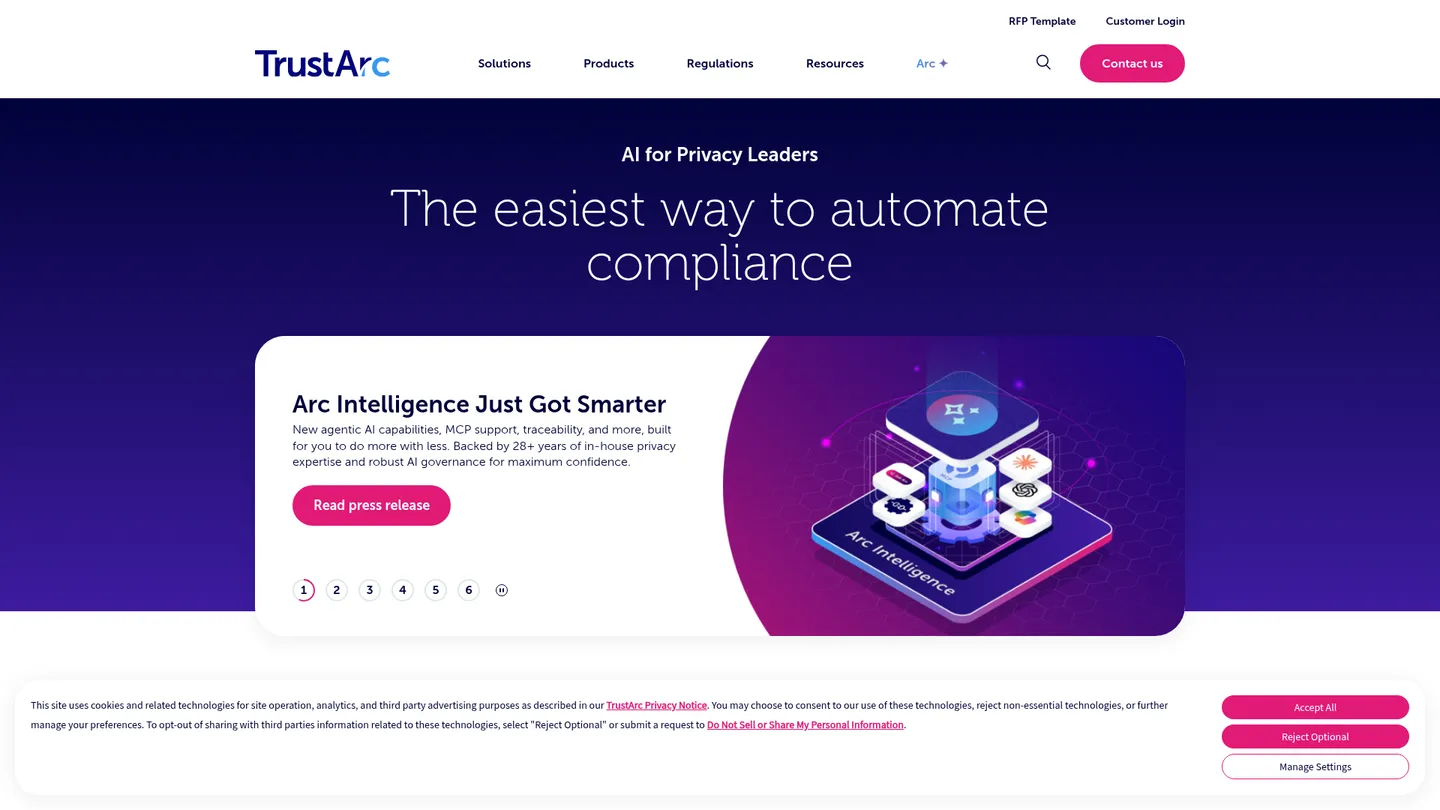
What is TrustArc?
Founded in 1997 and headquartered in Walnut Creek, California, TrustArc provides privacy management software and advisory services. Its platform covers data inventory, risk, assessments, consent, individual rights, privacy intelligence, and certification programs.
TrustArc is an enterprise privacy management platform that brings data inventory, privacy risk, assessments, consent, individual-rights requests, regulatory intelligence, and evidence into one operating environment. Teams can map personal-data flows and processing activities, calculate risk, route assessments, manage jurisdiction-specific deadlines, and produce audit-ready reports. Its Arc Intelligence features add AI-assisted record creation, evidence analysis, recommendations, and conversational workflows, while human reviewers retain responsibility for configuration, exceptions, and compliance decisions.
The product is broad rather than a lightweight single-purpose consent tool. Data Mapping & Risk Manager supports living inventories, GDPR Article 30 reporting, data-flow maps, vendor context, and risk-based assessment handoffs; Assessment Manager handles PIAs, DPIAs, TIAs, LIAs, vendor risk, and AI risk; and Individual Rights Manager coordinates access, deletion, correction, portability, restriction, objection, and applicable opt-out requests. Cookie Consent Manager adds scanning, categorization, banners, blocking, consent logs, and global preference controls. The trade-off is implementation complexity and modular scope.
TrustArc is best suited to privacy, legal, security, and compliance teams at organizations operating across multiple jurisdictions, domains, business units, or data systems. The vendor does not publish self-serve list pricing or standard public tiers: contracts are customized by modules, domains, assessments, requests, and deployment scope. Vendr reports a $15,120 median annual buyer payment across 57 purchases, while larger multi-module deployments can be substantially higher and implementation is typically additional.
Key features
Data mapping and inventory
Builds living personal-data inventories with AI-assisted records, data-flow mapping, third-party context, risk scoring, and GDPR Article 30 reporting.
Privacy assessments
Automates configurable PIAs, DPIAs, TIAs, LIAs, vendor-risk assessments, and AI-risk assessments with conditional workflows and remediation tracking.
Individual rights requests
Receives, verifies, routes, and fulfills jurisdiction-aware access, deletion, correction, portability, restriction, objection, and opt-out requests.
Cookie and consent management
Scans and categorizes trackers, configures consent banners, blocks cookies, records preferences, and reports on opt-in and opt-out activity.
Compliance controls
PrivacyCentral provides more than 20,000 controls mapped across 140+ privacy and security laws and standards, including 1,200+ common controls.
Privacy intelligence
Arc Intelligence supports AI-assisted evidence analysis, record population, recommendations, regulatory lookup, and conversational privacy workflows.
Integrations and automation
Connects privacy workflows through 300+ no-code connectors, an open API, and MCP connectivity for systems and AI assistants.
TrustArc pricing
TrustArc uses custom, modular contracts rather than public list prices. Vendr records annual buyer payments from $8,192 to $43,837, with a $15,120 median across 57 purchases; the low end is a transaction benchmark, not a published entry plan. Selected modules, domains, assessments, requests and implementation affect the quote.
| Plan | Price | What's included |
|---|---|---|
| Custom | QuoteModules and deployment scope determine price | Privacy platform access, selected data governance and risk modules, consent and rights workflows, assessments, integrations, support, and optional implementation services |
Free trial: Contact sales to discuss an evaluation.
Pros & cons
Pros
- Combines privacy inventory, assessments, consent, rights requests, and compliance controls in one platform.
- Its 20,000+ controls and 140+ mapped laws and standards support multi-jurisdiction programs.
- More than 300 no-code connectors reduce custom integration work for common privacy workflows.
- SOC 2 Type II controls, encryption, audit trails, and configurable evidence workflows support enterprise governance.
Cons
- Pricing is quote-based, modular, and difficult to budget without a detailed scoping process.
- Implementation and professional services can add materially to the first-year cost.
- The breadth of modules and configuration creates more operational overhead than a focused consent or DSAR tool.
- Automation still requires privacy professionals to review records, configure policies, and handle exceptions.
Who is TrustArc best for?
- Enterprise privacy teams managing processing records, vendors, and obligations across many jurisdictions.
- Organizations needing one workflow for data mapping, assessments, consent, and individual-rights requests.
- Companies that require configurable controls, evidence, audit trails, and regulator-ready reporting.
- Businesses with multiple websites, apps, systems, or AI use cases that need centralized privacy governance.
Frameworks and use cases
Integrations
Frequently asked questions
How much does TrustArc cost?
+
TrustArc publishes no standard list price. Vendr reports a $15,120 median annual payment across 57 purchases, with observed payments from $8,192 to $43,837; larger multi-module enterprise deployments can reach hundreds of thousands of dollars annually, before implementation.
How does TrustArc work and how long does implementation take?
+
Teams select modules, connect systems, configure workflows and jurisdictional rules, load evidence, and assign review responsibilities. Timing depends on the number of systems, domains, modules, and data processes, so TrustArc requires a scoped implementation rather than promising a universal deployment duration.
How does TrustArc compare with OneTrust?
+
Both provide broad enterprise privacy management. TrustArc emphasizes its 20,000+ controls mapped across 140+ standards, common-control mapping, privacy assessments, data mapping, consent, and rights workflows; buyers should compare required modules, integrations, implementation services, and negotiated quotes rather than rely on list-price assumptions.
What integrations does TrustArc support?
+
TrustArc advertises 300+ prebuilt no-code connectors, an open API, and MCP connectivity. Published examples include Google Consent Mode, Microsoft UET Mode, WordPress, Shopify, Drupal, Joomla, Segment, and Tealium, with connectors supporting consent syncing, rights fulfillment, and vendor onboarding.
Who is TrustArc for?
+
It is designed for privacy, legal, security, marketing, and compliance teams managing data across multiple jurisdictions and business systems. Its breadth is most useful for mid-market and enterprise programs that need inventory, assessments, consent, rights operations, evidence, and reporting together.
Is TrustArc secure and accurate?
+
TrustArc's trust center documents TLS 1.2 in transit, AES-256 encryption at rest, intrusion detection, logging, incident response, and annual assessment against SOC 2 Type II controls. Its legal and privacy content and AI-assisted recommendations reduce repetitive work, but teams remain responsible for reviewing evidence, configuring rules, and making compliance judgments.
Sources
Facts and pricing verified on October 19, 2026. Vendors change pricing often, so confirm with TrustArc before buying. How we research