
 OneTrust
 TrustArc
 Transcend
 DataGrail
 Ketch
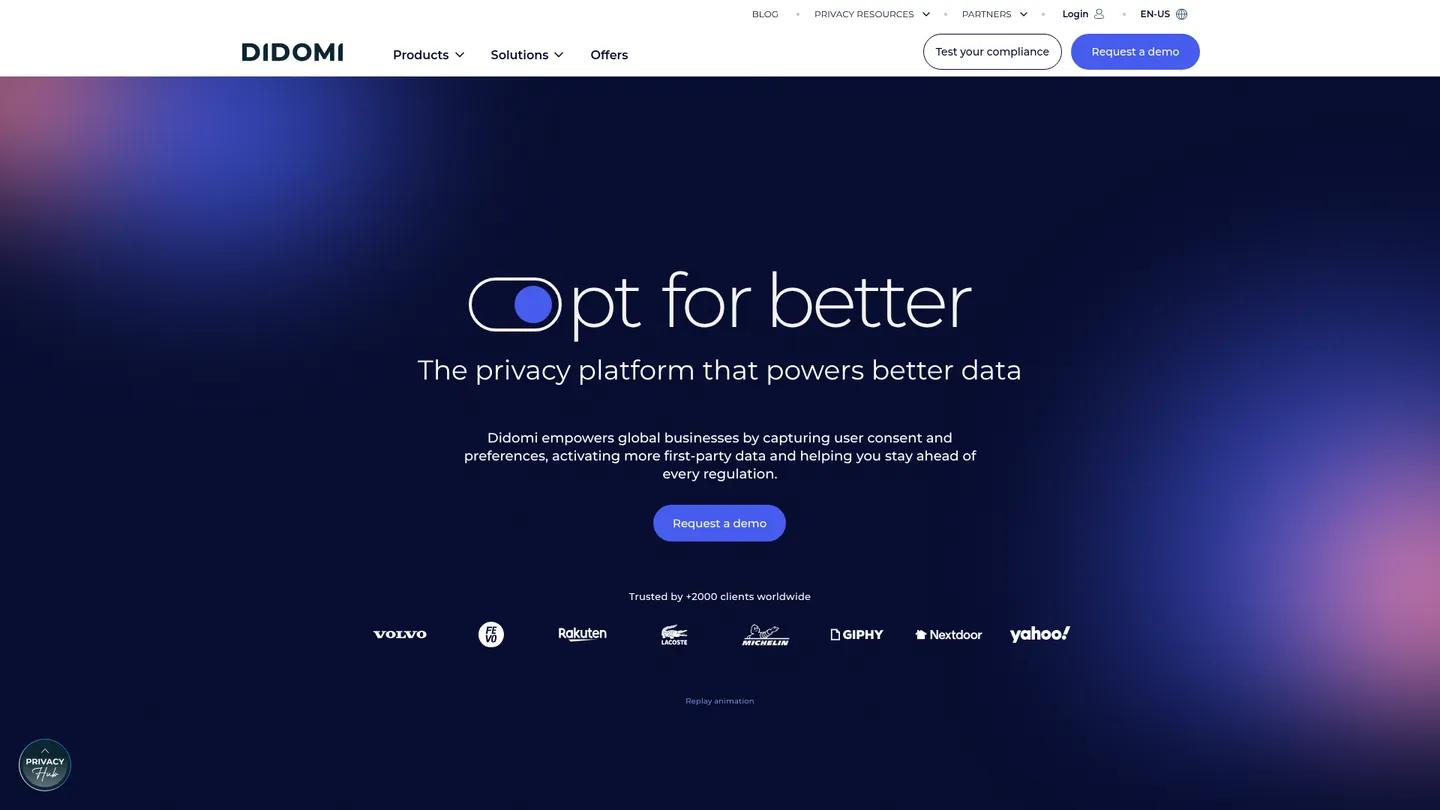
What is Didomi?
Founded in 2017 and headquartered in Paris, Didomi provides consent management, preference management, compliance monitoring and privacy-request tools. The company reports 1,500+ clients and expanded through Addingwell and Sourcepoint acquisitions in 2025.
Didomi is an enterprise privacy-operations platform that collects, stores and distributes consent and preference choices across websites, mobile applications, connected TV and other digital properties. Teams configure geo-targeted notices and preference experiences in a central console, while SDKs, APIs, webhooks and exports pass validated choices to downstream systems. The platform supports cross-domain and cross-device scenarios, multilingual experiences, audit trails and consent signals used by advertising, analytics and marketing tools.
Its product breadth covers consent management, preference management, compliance reports, advanced compliance monitoring, privacy requests, analytics, integrations and server-side tagging through Addingwell. Framework support includes IAB TCF 2.2, GPP, Google Consent Mode, Microsoft UET Consent Mode and AWS Consent Mode; banners support 45+ languages. The trade-off is enterprise complexity: integrations are separately priced, implementation commonly involves solution engineers, and the company does not publish a conventional CMP list price.
Didomi is best suited to multinational enterprises, publishers, media groups and organizations managing multiple brands, jurisdictions, domains and devices. Its customer examples include Orange, Yahoo, Europcar, Société Générale and Gaming1. CMP pricing is quote-based and driven by monthly unique visitors and selected modules; the AWS Marketplace lists $3,000 per 12 months for one MUV dimension, while the acquired server-side-tagging product has a free 100,000-request plan and paid usage or enterprise options.
Key features
Consent management
Deploy geo-targeted, branded consent notices across web, mobile, apps, CTV and other supported environments.
Preference management
Let people manage communication, marketing and data-sharing choices through configurable preference widgets and journeys.
Compliance monitoring
Scan and monitor domains, vendors and trackers with compliance reports and programmable scenarios.
Privacy requests
Collect, route and track data-subject requests through configurable forms, widgets and workflows.
Consent analytics
Measure consent rates, user preferences and compliance performance from console dashboards.
Data integrations
Share consent through APIs, real-time webhooks, daily batch exports and marketplace connectors.
Server-side tagging
Use Addingwell infrastructure for first-party, server-side tag delivery, monitoring and consent-aware data collection.
Didomi pricing
CMP and preference products use custom pricing tied to monthly unique visitors, modules and implementation requirements. AWS Marketplace lists $3,000 per 12 months for one monthly-unique-visitor dimension. Didomi’s developer documentation says integrations are priced separately, while Addingwell offers free, pay-as-you-go and enterprise server-side-tagging options.
| Plan | Price | What's included |
|---|---|---|
| Essential | CustomCMP | Multi-regulation compliance, consent notices, branding and consent collection |
| Advanced | CustomCMP and monitoring | Essential features, advanced compliance monitoring, programmable scans and synchronization |
| Premium | CustomPrivacy strategy | Advanced features, privacy strategy, unified consent and granular preference management |
| Addingwell Free | FreeServer-side tagging | 100,000 requests, free plan for testing server-side tagging |
| Addingwell Enterprise | CustomServer-side tagging | Premium private network, multi-region infrastructure, monitoring, SLA, annual contract and dedicated account management |
Free trial: No CMP free trial is published; Addingwell offers a free plan with 100,000 requests.
Pros & cons
Pros
- Broad framework coverage includes IAB TCF 2.2, GPP and several consent-mode standards.
- Geo-targeting and 45+ notice languages support localized global deployments.
- APIs, webhooks, exports and native connectors give teams several integration patterns.
- ISO/IEC 27001:2022 certification and audit-oriented consent history support enterprise procurement.
Cons
- CMP pricing is custom, so buyers cannot calculate a standard self-serve subscription online.
- Integrations are separately priced and complex deployments may require solution-engineering support.
- The platform’s enterprise breadth can be more than smaller teams need.
- Daily batch exports are not real-time, and webhook delivery can risk event loss if the receiving service is unavailable.
Who is Didomi best for?
- Multinational companies coordinating consent across many jurisdictions, brands and domains.
- Publishers and media businesses managing advertising consent and complex vendor ecosystems.
- Privacy, legal, marketing and engineering teams that need one shared consent operations console.
- Organizations deploying consent across websites, mobile apps, CTV and cross-device journeys.
Frameworks and coverage
Integrations
Notable customers
Frequently asked questions
How much does Didomi cost?
+
Didomi does not publish standard CMP list prices. AWS Marketplace lists $3,000 per 12 months for one monthly-unique-visitor dimension; final pricing depends on traffic, modules, integrations and services.
How does Didomi work?
+
Teams configure notices, purposes, vendors and regional rules in the console. SDKs and APIs collect choices, then webhooks, batch exports or connectors distribute consent to internal and third-party systems.
How does Didomi compare with OneTrust?
+
Both target enterprise privacy programs, but Didomi emphasizes consent and preference experiences across web, mobile and CTV, with a strong consent-signal integration layer. OneTrust has a broader governance and risk portfolio; the right choice depends on whether CMP depth or wider privacy-workflow breadth is the priority.
What integrations does Didomi support?
+
Documented integrations include Salesforce, HubSpot, Mailchimp, Actito, Shopify, WordPress, Google Tag Manager and Adobe Experience Cloud. Didomi also provides a Consents API, webhooks and batch exports, and says bespoke connectors can be built for enterprise needs.
Who should buy Didomi?
+
It is designed for enterprises, publishers and media organizations with multiple properties, regions, devices or advertising vendors. Smaller companies with one website and simple consent needs may find the implementation and custom pricing disproportionate.
Is Didomi secure and accurate?
+
Didomi states that it is ISO/IEC 27001:2022 certified and uses encryption, DDoS mitigation, intrusion detection, vulnerability scanning and separated backups. Its platform records consent history for auditability, but buyers should validate configuration, regional legal requirements and integration behavior during implementation.
Sources
Facts and pricing verified on October 19, 2026. Vendors change pricing often, so confirm with Didomi before buying. How we research